01614578100
 hello@alexanderclifford.co.uk


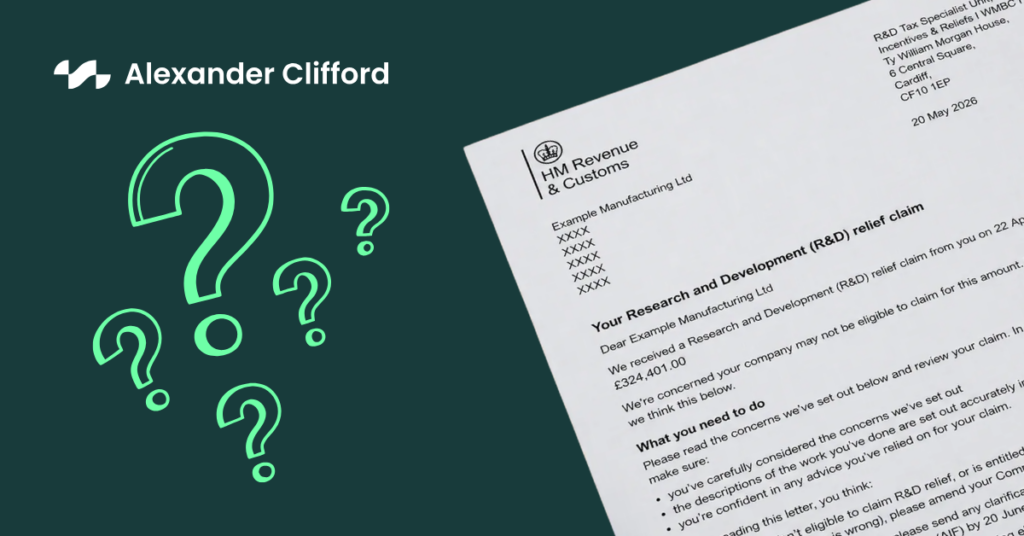
It can be daunting opening an HMRC enquiry letter after submitting an R&D tax relief claim, but it doesn’t have to be with trusted guidance. It is important for businesses to remember that an enquiry doesn’t automatically mean their claim is incorrect.
An enquiry may be opened due to a variety of reasons, including missing information, inconsistencies within the claim or questions about the qualifying R&D activities or expenditure records.
The way a company responds to HMRC can have a direct impact on how quickly and smoothly the enquiry is resolved. Taking a cautious approach, providing accurate information and responding within the given deadline are all essential steps in this process.
In this article, we’ll explain what to do and not to do when responding to an HMRC R&D enquiry. You’ll learn what to expect, common mistakes to avoid and the practical steps businesses should take to support their R&D tax relief claim.
Why would HMRC open an enquiry into an R&D claim?
When receiving an HMRC R&D enquiry letter, businesses must check the deadline given and ensure there is enough time to prepare the evidence required and also to submit a robust response.
HMRC may open an enquiry to check whether a claim complies with the legislation, including whether the activities qualify and whether the expenditure has been calculated correctly.
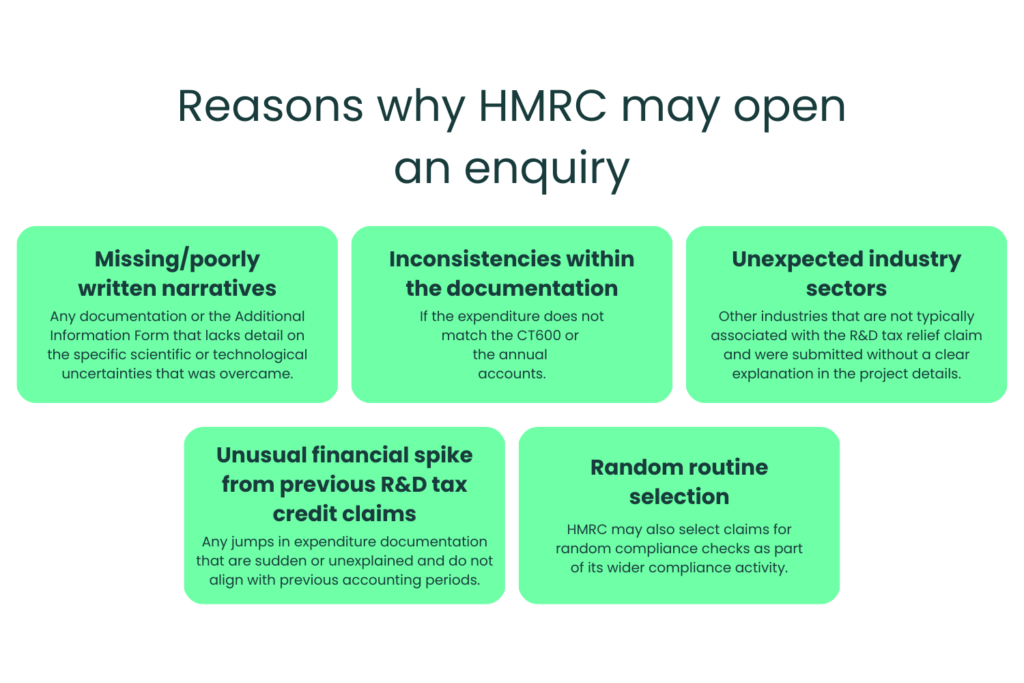
There are some common triggers for an R&D enquiry which include:
Missing or poor narratives
The documentation or Additional Information Form (AIF) does not provide enough detail about the scientific or technological uncertainties the business sought to overcome.
Inconsistencies within the documentation
If the R&D expenditure does not match the Company Tax Return (CT600) or the annual accounts.
Unexpected industry sectors
Unexpected industries that were not associated with the R&D tax relief claim and were submitted without a clear explanation in the project details.
Unusual financial spikes from previous R&D tax credit claims
If there is a jump in the finances that are sudden or unexplained which don’t align with previous years.
Random routine selection
HMRC may also select claims for random compliance checks as part of its wider compliance activity.
How do you respond to an HMRC R&D enquiry letter?
When it comes to responding to an R&D enquiry letter from HMRC, we strongly recommend consulting with a credible R&D tax advisor before submitting a response. Businesses should never ignore the letter as this can result in more serious penalties.
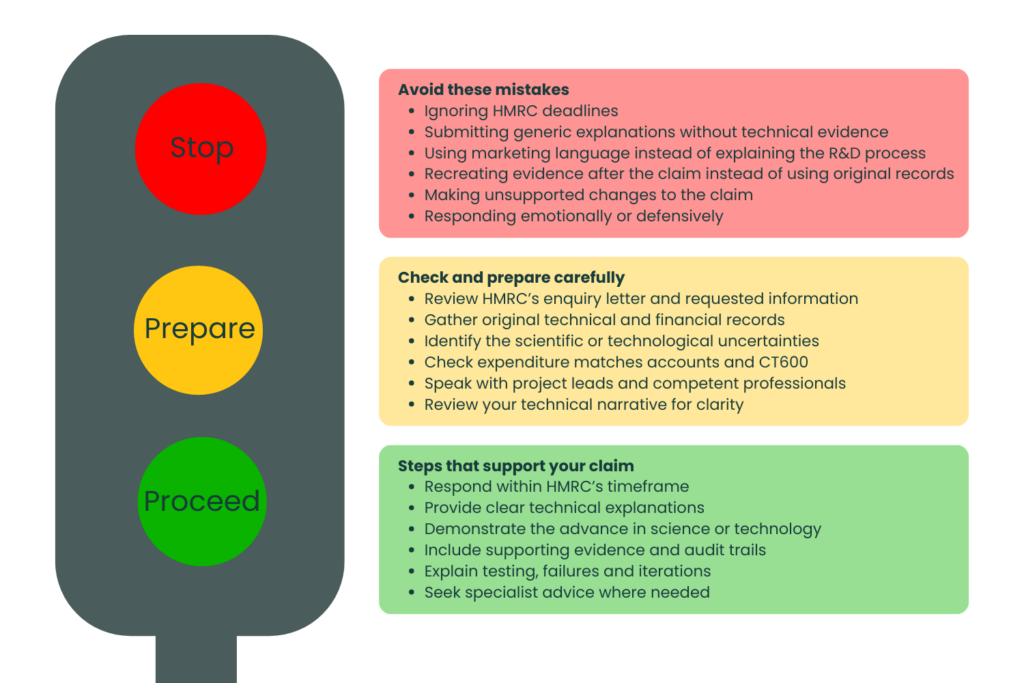
Gather all available technical information, original claim documents and financial records to answer the questions with substantial evidence that is genuine and aligns with the criteria.
Which documents and evidence could support your R&D claim?
A well-supported R&D claim requires a detailed chronological audit trail that evidences the scientific or technological uncertainties encountered, the qualifying activities undertaken, the progress made throughout the project and the associated qualifying expenditure.
A robust claim includes evidence such as:
- Contemporaneous documentation
- Expenditure records
- Iterative evidence
- Project and technical records
We have published an article that explains exactly what should be included in an R&D tax relief claim. You can read more about what documentation businesses need to provide for an eligible R&D tax relief claim here.
What mistakes should you avoid during an HMRC R&D enquiry?
During an HMRC enquiry into an R&D tax relief claim, businesses often have limited time, commonly 30 days from the date of the letter, to gather supporting evidence and respond to HMRC’s questions. This can increase the risk of inaccuracies, making it important that all information provided is complete, accurate and supported by appropriate documentation.
Our key tips would be to:
- Avoid missing deadlines.
- Do not use marketing language or focus on commercial challenges.
- Avoid generic responses that are not supported by the project’s own technical evidence.
Instead of these common pitfalls, we recommend maintaining contemporaneous records that document the scientific or technological uncertainties encountered, the work undertaken to resolve them and the evidence supporting the qualifying R&D expenditure claimed.
How long does an HMRC R&D enquiry usually take?
Timescales will vary depending on the complexity of the enquiry, the quality of the evidence provided and HMRC’s backlog of claims to review. For more complex claims or businesses that have not been able to provide the requested information, can sometimes face a longer completion time.
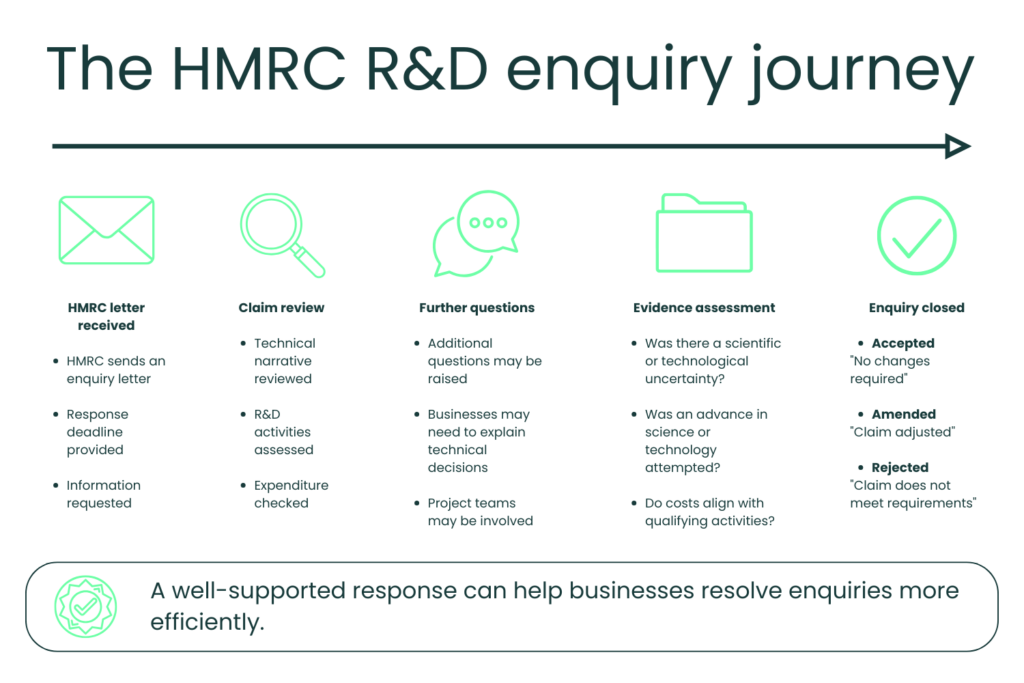
An HMRC R&D enquiry will typically progress through the following stages:
The initial letter
HMRC will open the enquiry and request a series of information. This request will ask for technical justifications and financial breakdowns to support the claim.
Back-and-forth correspondence
HMRC may ask further questions before reaching a conclusion. If the initial response does not align with the expected criteria, this will prolong the outcome of the enquiry.
Meetings with the company
HMRC case officers may also request a meeting with the business’ internal team and advisors to solidify the authenticity of the evidence.
Resolution
Once the inspectors at HMRC have spoken with the team and reviewed the evidence submitted, they will either close the enquiry with no changes necessary, they may amend the claim or in more serious cases, reject the claim entirely.
Because R&D claims often involve complex scientific or technological uncertainty, businesses should ensure their technical narrative and other supporting documentation is well evidenced. This will create a smoother and more time-efficient process.
Can you amend your R&D claim during an HMRC enquiry?
Yes, you are able to amend an R&D tax relief claim during an enquiry. However, it depends on whether the company is fixing a mistake in the claim documentation or if they are trying to increase the claim to the correct amount. HMRC must be notified of any changes made.
Reducing the claim
If a company later realises that they have overclaimed for R&D tax relief, they should disclose this error immediately to their case worker. Voluntarily amending the submission can reduce the risk of penalties for errors which are careless or deliberate.
Increasing the claim
Once an enquiry has opened, there are restrictions on amending the Corporation Tax return. HMRC may consider additional information where it is relevant to the enquiry, but this does not necessarily allow the company to increase its claim.
What happens after HMRC completes its enquiry?
After the enquiry is complete, HMRC will issue a formal Closure Notice outlining a conclusion. If your claim is then accepted as it is, there will be no further action required.
HMRC will reach one of the following outcomes at the end of the enquiry process:
- If there are no changes needed, the enquiry will be formally closed with no further payment required.
- If the company owes more tax, HMRC will request payment within 30 days. The business normally owes interest on the late payment and may face penalties depending on the reason for the error.
- If HMRC concludes that the company is due a repayment, they will issue any amount due. Depending on the circumstances, repayment interest may also be payable.
When should you seek professional support with an R&D enquiry?
Companies should seek professional advice immediately after receiving a letter from HMRC regarding an enquiry. Additionally, engaging with an expert adviser before submitting an R&D tax credit claim is crucial to avoid the risk of enquiry.
An R&D tax credit adviser can review your drafted claim against the supporting financial and technical records to identify any inconsistencies, gaps or areas that may require further evidence. R&D advisers will also assess whether the claim is aligned with HMRC’s legislation.
An adviser will review the company’s technical narrative to ensure it clearly explains the scientific or technological uncertainties they sought to resolve, the work undertaken to address those uncertainties and the scientific or technological advancement the project aimed to achieve.
They also help ensure the claim is supported and presented in a way that consistently aligns with the statutory requirements.
Situations where an R&D tax specialist may be able to help include:
HMRC compliance checks
If HMRC opens an enquiry or issues an R&D “nudge” letter, a specialist can help prepare technical explanations, review the evidence supporting your claim, and assist with correspondence or meetings.
Demonstrating reasonable care
Seeking professional advice may help demonstrate that reasonable care was taken when preparing your claim. This can be relevant if HMRC later challenges part of the claim and considers whether penalties should apply.
Applying complex R&D legislation
An R&D tax relief specialist can help interpret the legislation and identify eligible expenditure, including areas such as subcontracted R&D, externally provided workers (EPWs) and other complex cost categories.
Disputing or appealing the claim
If an HMRC enquiry cannot be resolved through normal correspondence, a specialist can advise on disputing the enquiry or support your business through the Tribunal appeals process where appropriate.
Closing thoughts
If HMRC opens an enquiry into your R&D tax relief claim, receiving advice from an experienced R&D tax specialist can help you respond accurately and confidently, even if they were not involved in preparing the original claim. Managing an enquiry without specialist support, or relying on an adviser without relevant R&D tax relief expertise, can increase the risk of misunderstandings and unnecessary delays.
This is particularly relevant where a claim was prepared in-house or by a general accountancy practice that may not regularly deal with the technical and legislative requirements of R&D tax relief or HMRC’s enquiry process.
At Alexander Clifford, we are trusted by businesses across the nation who have been able to claim their R&D tax relief through the correct scheme smoothly and efficiently. If you are searching for further advice regarding the topic of HMRC enquiries, please don’t hesitate to get in touch with a member of our team and we would be happy to guide you through the process with clarity and care.