01614578100
 hello@alexanderclifford.co.uk




If HMRC has opened an R&D compliance check after key project staff have left, companies must continue to support their R&D tax credits claim. The process begins with identifying the technical and financial evidence that is remaining after the departure, who is eligible to explain the scientific or technological work undertaken, and whether former employees can provide factual context.
Staff departures can increase the difficulty of the compliance check process, particularly where scientific or technological knowledge was not documented at the time. They do not determine whether the underlying R&D activity qualifies on their own.
Existing project records, financial documentation, input from remaining competent professionals and, where appropriate, information from former employees can all help establish the basis on which the R&D tax relief claim was made.
In this article, we will explain how businesses can approach an HMRC R&D compliance check when members of the original project team have left, what evidence may still be available and where specialist R&D support can help.
Can HMRC still check an R&D tax relief claim after key staff have left?
Yes, it is possible for HMRC to open a compliance check into an R&D tax relief claim even after key members of staff have left the company.
The reason being is that the R&D claim is linked to the company along with the Company Tax Return, not to the individual employees who prepared the claim or carried out the relevant scientific or technological activity.
If staff members such as engineers, project managers, developers or directors have left, the company still remains responsible for the accuracy of the claim and the information included in it.
Staff departures also don’t change the company’s responsibility for the return or, by themselves, alter the statutory rules governing HMRC enquiries and assessments.
However, what can change is the company’s ability to explain and evidence the claim. If people with first-hand knowledge of the project are no longer available, existing technical and financial records become increasingly important.
Project plans, design records, emails, development logs, meeting notes and financial records can all help establish what activity took place, when it took place and how the expenditure included in the R&D tax relief claim was calculated.
Where important technical knowledge was held primarily by employees who have departed from the company, reconstructing solid evidence may become difficult. The first step is to establish what evidence and technical knowledge still exists.
What should companies do if HMRC opens an R&D compliance check after staff have left?
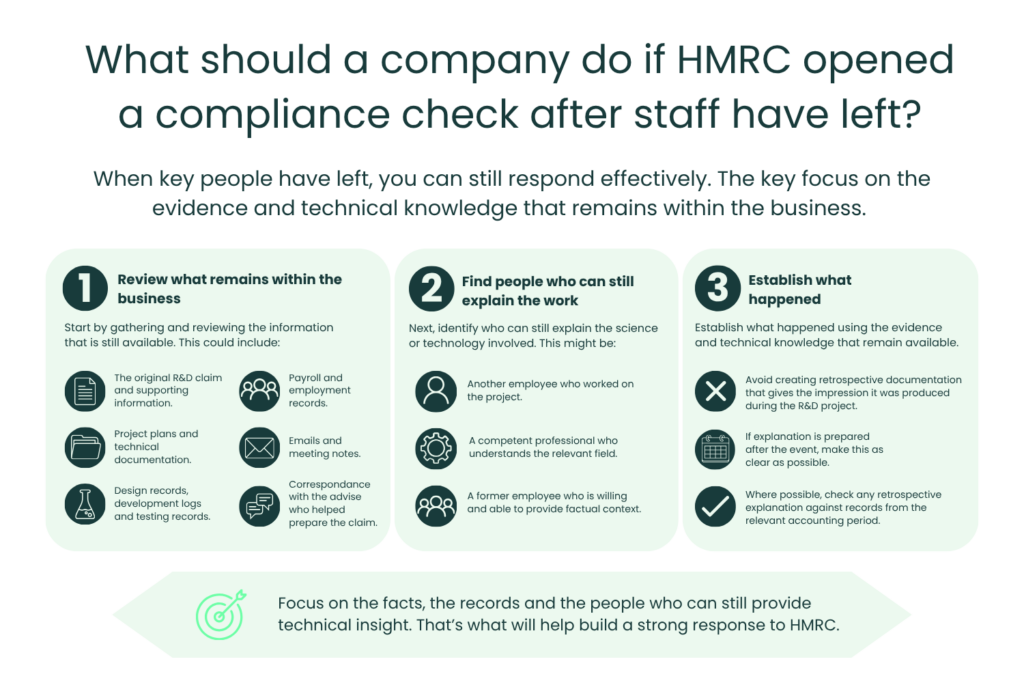
Start by reviewing the information that remains within the business.
Examples include:
- The original R&D claim and supporting information
- Project plans and technical documentation
- Design records, development logs and testing records
- Emails and meeting notes
- Payroll and employment records
- Correspondence with the adviser who prepared the claim
Records relevant to the R&D claim should be preserved while the compliance check is ongoing.
Next, identify who can still explain the science or technology involved in the work. This might be another employee who worked on the project, a competent professional who understands the relevant field, or a former employee who is willing and able to provide factual context.
The aim is not to recreate a perfect project file after the work has taken place. It is to establish what happened using the evidence and technical knowledge that is available and can be supported.
Businesses should avoid creating retrospective documentation that gives the impression it was produced during the R&D project. If an explanation is prepared after the event, that should be clearly outlined. Where possible, it should also be checked against records from the relevant accounting period.
What does HMRC look for during an R&D compliance check?
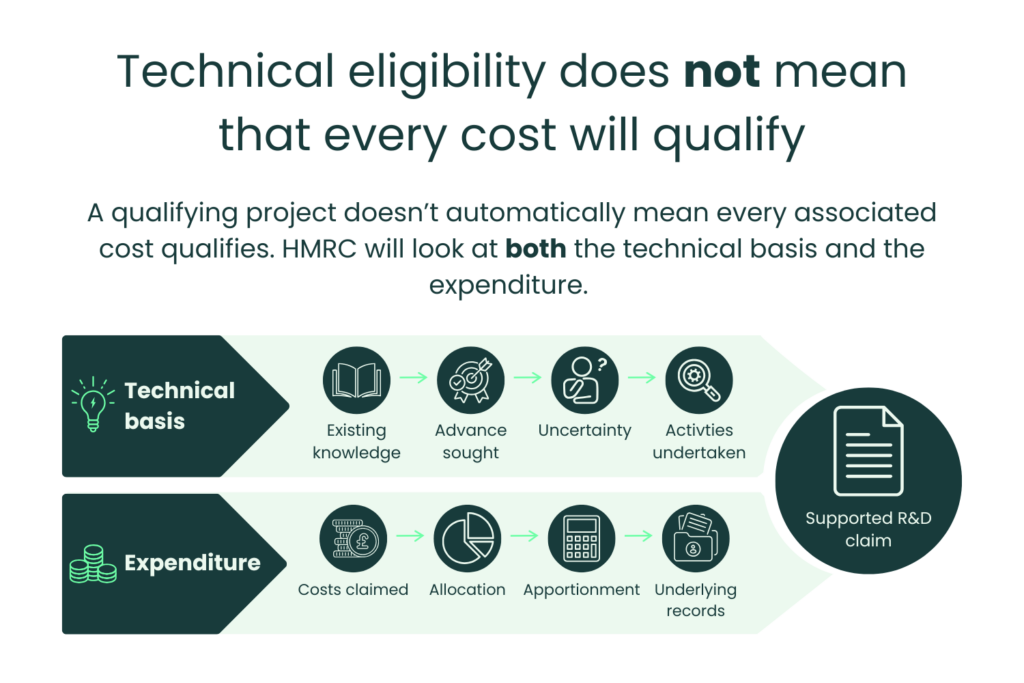
HMRC may examine both the technical basis of the claim and the expenditure included within it.
For technical eligibility, the company needs to explain whether the project sought an advance in a field of science or technology through the resolution of scientific or technological uncertainty.
This includes:
- Explaining the existing knowledge or capability in the relevant field
- Identifying the advance being sought
- Showing why the scientific or technological uncertainty wasn’t readily deducible by a competent professional working in that field
The company should also be able to explain the activities undertaken to resolve the uncertainty. This can include activities that directly contributed to resolving the scientific or technological uncertainty and, where relevant, qualifying indirect activities.
Project records, technical documentation, testing information, correspondence and other evidence may help outline what work was undertaken and the time it happened. HMRC may also review whether qualifying R&D expenditure has been identified and calculated correctly.
A technically qualifying project doesn’t mean every associated cost qualifies for R&D tax relief. HMRC may examine the categories of expenditure claimed, how costs have been allocated between qualifying R&D and other activities and whether any apportionment methodology used can be explained and supported.
HMRC may also request underlying records to verify expenditure included within the claim.
Can former employees help with an HMRC compliance check?
Yes. Former employees may be able to help, particularly where they were directly involved in the qualifying Research and Development activity or were competent professionals working in the relevant field.
A former employee might be able to explain the existing knowledge or capability at the time, the advance being sought, the scientific or technological uncertainties encountered and the work undertaken to try to resolve them.
This can be particularly useful where the current team wasn’t involved in the project and doesn’t have first-hand knowledge of the work.
A retrospective explanation can still help establish the facts, particularly where it comes from someone directly involved in the project. It should be clearly identified as retrospective and tested against contemporaneous records where those records are available.
For example, a former engineer’s recollection of a technical problem may be considered alongside:
- Design records
- Testing results
- Emails
- Meeting notes
These must all be from the relevant period.
Businesses shouldn’t create statements later in the project process that suggests it was written at the time of the R&D activity as this can raise red flags of non-compliance to HMRC.
If a former employee can’t be contacted, the company will need to work from the evidence and technical knowledge that is available. This might include company records and input from other competent professionals who understand the relevant field.
The company remains responsible for the accuracy of the claim and the information supplied to HMRC, regardless of whether an explanation comes from a current or former employee.
What are the risks of relying on reconstructed evidence?
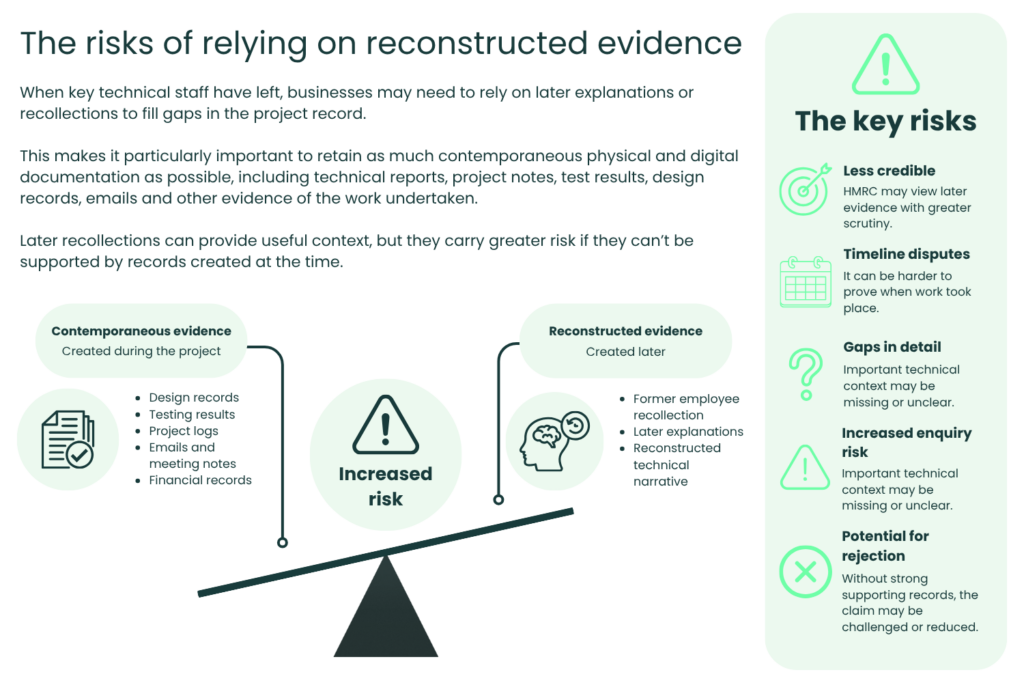
Evidence prepared after the event can still be relevant to an HMRC compliance check. The distinction between contemporaneous records and explanations reconstructed later should remain clear and backed up with sufficient evidence.
As time passes, there is a greater risk that details will be forgotten, recollections will differ or explanations will be difficult to verify against the underlying project records.
This can make it harder to establish:
- The existing knowledge or capability in the relevant field at the time
- The advance in science or technology being sought
- The scientific or technological uncertainties encountered
- Why those uncertainties weren’t readily deducible by a competent professional
- The activities undertaken to try to resolve those uncertainties
- How R&D expenditure was allocated to qualifying activities
There may also be inconsistencies between later recollections and records created during the project.
These issues don’t automatically make retrospective evidence unusable. They affect how the evidence should be assessed and supported.
Where HMRC concludes that eligibility or expenditure hasn’t been adequately supported, it may seek to adjust the claim. If an inaccuracy is identified, penalty considerations may also arise where the relevant statutory conditions are met.
This is why the focus should be on establishing a coherent evidence trail rather than producing documentation simply to fill gaps.
How can businesses prepare before key R&D staff leave?
Where possible, businesses should maintain enough information to explain and support the basis of an R&D claim without relying entirely on the memory of individual employees.
That doesn’t necessarily mean creating a separate R&D record for every technical decision.
Existing business records may already contain useful evidence. Project management systems, design documentation, development records, testing results and technical correspondence can help establish what work took place. Payroll and accounting records can support the expenditure included within the claim.
It’s also useful to identify the competent professionals closest to the qualifying activity when the claim is prepared.
They should be able to explain the existing knowledge or capability in the relevant field, the advance being sought, the scientific or technological uncertainty encountered and why it wasn’t readily deducible.
Bringing this technical explanation together with the financial records behind the claim reduces the need to reconstruct the position entirely from memory if HMRC raises questions later.
When might specialist R&D support help?
A compliance check can become more difficult when the people who originally prepared the claim or provided the technical information are no longer available.
An experienced R&D tax adviser can help review the original claim, assess the evidence that remains and identify areas where further explanation may be needed.
The purpose should be to establish whether the available evidence supports the claim against the R&D criteria HMRC is considering. It shouldn’t be to retrospectively construct a technical narrative that isn’t supported by the underlying facts.
Specialist support can also help bring together the technical and financial sides of the response. For example, the technical explanation of qualifying activities should be consistent with the methodology used to identify and apportion qualifying expenditure.
The company remains responsible for the accuracy of its claim and the information provided during the compliance check.
Closing thoughts
Staff leaving a business doesn’t remove the company’s responsibility for an R&D tax relief claim. It also doesn’t, by itself, determine whether the underlying activity qualifies.
What it can change is the evidence available to explain and support the claim.
Technical records, project documentation, development records, emails, payroll information and other evidence may help establish what qualifying activity took place and which costs were included. Former employees can also provide useful factual context where they were directly involved in the work.
The key is to distinguish clearly between records created at the time and explanations reconstructed later, then assess the available evidence against the R&D criteria relevant to the claim.
Where key technical staff have left, specialist support can help establish what evidence remains, test it against those criteria and prepare a structured response to HMRC.
Alexander Clifford supports businesses responding to HMRC R&D compliance checks, including cases where employees involved in the original projects are no longer available. If you’ve received an HMRC compliance check letter and need help reviewing the technical or financial evidence behind the claim, please don’t hesitate to get in touch.