01614578100
 hello@alexanderclifford.co.uk



Preparing an R&D tax relief claim has become more of a detailed process compared to previous years. New information requirements, changes to the schemes and increased HMRC scrutiny mean accountancy firms have more to consider when preparing claims for their clients.
Alongside the financial calculations, firms need to establish whether the activities meet the definition of R&D for tax purposes, how the scientific or technological uncertainties are evidenced and whether the supporting information is consistent with the expenditure being claimed.
For accountancies without dedicated R&D advisers in-house, outsourcing claims to an R&D tax credit specialist can be an efficient path to take.
In this guide, we look at why some accountancy firms outsource R&D tax relief claims, what has changed in the claims process and where specialist support can help.
Why are more accountancy firms outsourcing R&D tax relief claims?
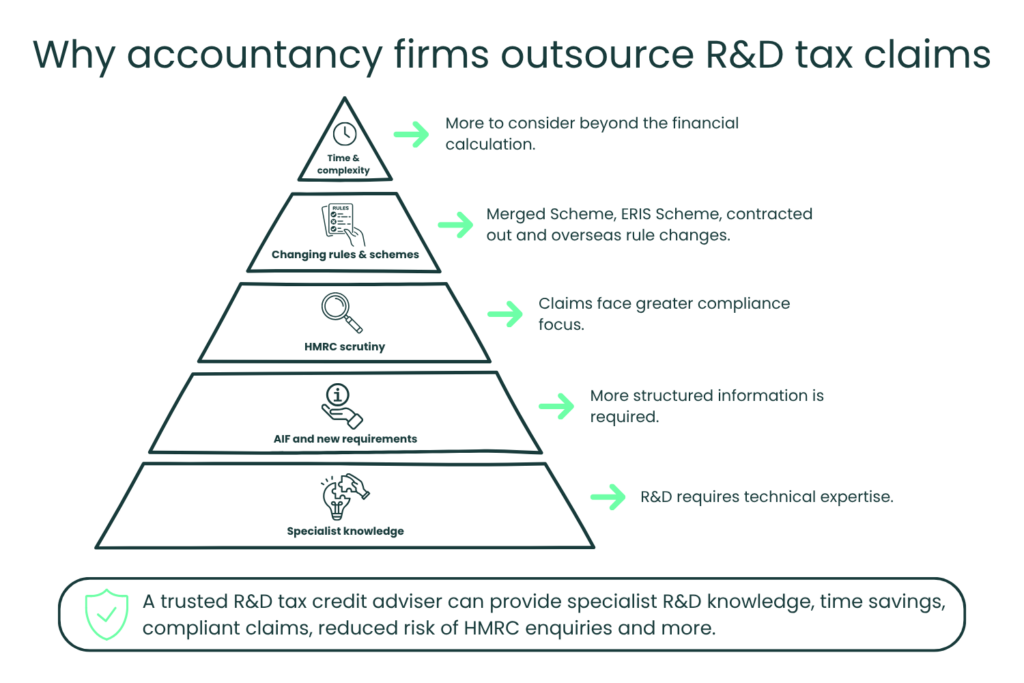
R&D tax relief has never been purely about the financial evidence gathered from a project. Accountants need to identify eligible R&D expenditure, but a claim must also establish whether the underlying activities qualify as R&D for tax purposes.
This involves considering the advance sought in a scientific or technological field, the baseline knowledge or capability in those fields, and the scientific or technological uncertainties the project sought to resolve.
For accounting periods beginning on or after 1 April 2024, the Merged Scheme and Enhanced R&D Intensive Support Scheme (ERIS) replaced the previous SME R&D relief and RDEC schemes. Changes to contracted-out R&D and restrictions on certain overseas expenditure mean that firms also need to establish which rules apply to their project before determining what expenditure can be included in the claim.
Some companies must also submit a Claim Notification Form (CNF) before making an R&D claim. Notifying HMRC is required depending on the company’s circumstances and previous R&D claim history. Read our article about the CNF for further information.
For accountancy firms handling relatively few R&D claims each year, keeping up with these requirements while maintaining the necessary technical knowledge may not always be practical.
Outsourcing to a trusted R&D tax adviser will lift the stress of the claim process by handing it over to a team of experts in the Research and Development tax credits field.
Why is there more work involved in preparing an R&D tax relief claim?
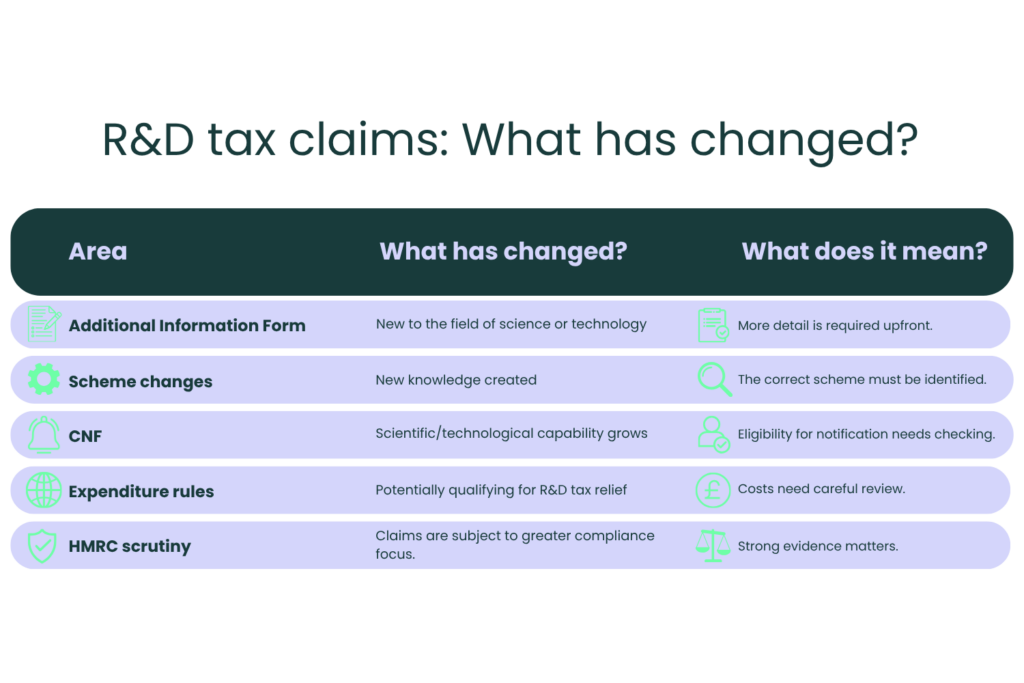
One of the main changes to the claims process was introducing the Additional Information Form. The Additional Information Form (AIF) became a mandatory step for R&D claims submitted from August 2023. Accountants are required to provide more than a breakdown of expenditure. They also need sufficient information from the people involved in the projects to establish why the activities qualify and how the expenditure relates to that work.
The R&D claim expenditure rules also changed. New rules apply to areas including contracted-out R&D and overseas expenditure.
Preparing a claim involves establishing which scheme and rules apply, identifying qualifying activity, applying the correct expenditure treatment and making sure the technical and financial elements are consistent and well-evidenced.
How has the Additional Information Form changed the R&D claims process?
The Additional Information Form has made structured technical information about R&D projects and expenditure a mandatory part of the claims process. The AIF should be submitted before the Company Tax Return (CT600) containing the R&D claim.
Some of the main requirements include:
- Digital submission: The AIF is completed and submitted online to HMRC.
- Submission before the CT600: The Additional Information Form should be provided before the Company Tax Return containing the R&D claim.
- Project information: Companies provide details about their qualifying projects, expenditure and the people involved in preparing the claim.
- Consistency: Information provided through the AIF needs to align with the R&D claim included in the Company Tax Return (CT600).
- Technical information upfront: HMRC receives information explaining the basis of the qualifying R&D as part of the claims process.
Why is HMRC scrutinising R&D tax relief claims more closely?
HMRC has increased its focus on R&D tax relief compliance as part of its work to tackle error and fraud within the schemes.
Businesses need to be able to demonstrate how the activities included within a claim meet the definition of qualifying R&D under HMRC guidelines.
A project won’t qualify for R&D tax relief simply because it is innovative, commercially challenging or new to the company. There must be clear evidence of qualifying R&D activity. Qualifying R&D must seek an advance in overall knowledge or capability in a field of science or technology. The scientific or technological uncertainty must be one that a competent professional working in the relevant field could not readily resolve from the overall knowledge or capability in that field.
The AIF also gives HMRC structured information about qualifying projects and expenditure as part of the claims process. This means the technical basis of a claim and the expenditure associated with it need to be considered together.
R&D tax relief requires a different skill set from regular accountancy. Determining whether a project contains qualifying R&D activity means assessing advances in science or technology, technical uncertainties and the position of a competent professional against the baseline knowledge or capability in the relevant field. These are more specialised judgements to be made, not general accounting or tax calculations.
For this reason, we believe R&D claims should be prepared by dedicated R&D specialists rather than treated as an extension of a company’s routine accountancy work. An R&D specialist should be able to examine the technical and financial basis of the claim, identify the qualifying technical documentation and eligible expenditure, and prepare supporting information that reflects HMRC’s strict requirements.
What should an R&D tax relief specialist handle for an accountancy firm?
The process for an R&D tax relief claim is straightforward thanks to our team of experts at Alexander Clifford. Our mission statement is to achieve the highest R&D tax credits claim relief for your innovation, quickly and compliantly, with no stress. We pride ourselves on being time efficient and transparent with how our service operates.
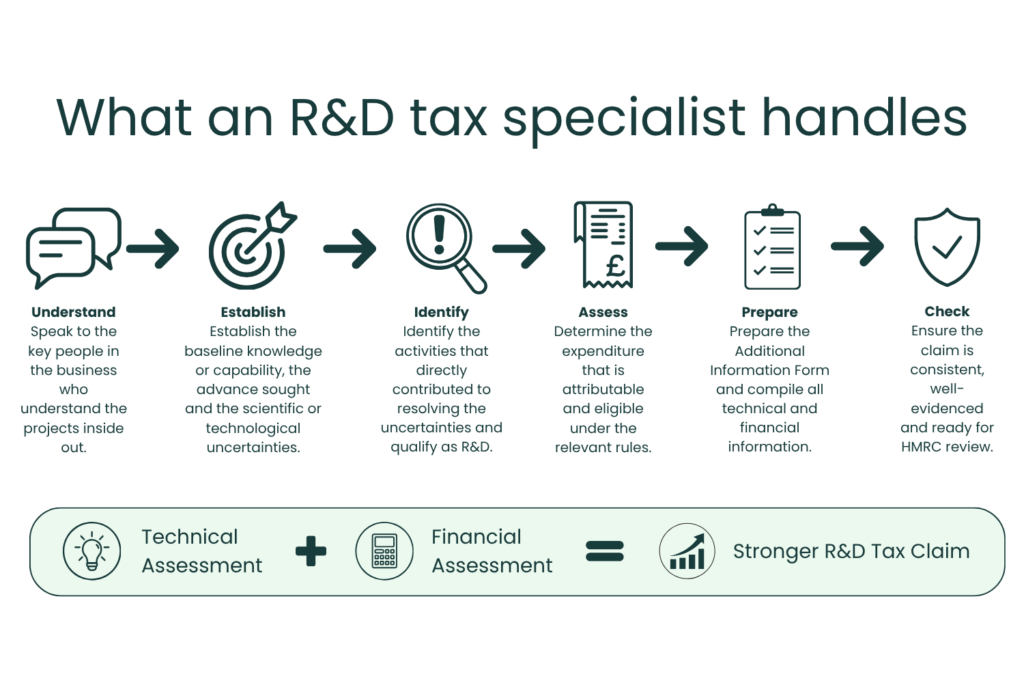
The process starts with us speaking to the competent professionals within the business who understand the projects being claimed for. The specialist should establish the baseline knowledge or capability in the relevant field, the advance the company sought to achieve and the scientific or technological uncertainties encountered. They should then identify which activities directly contributed to resolving those uncertainties and consider the expenditure attributable to the qualifying R&D.
One of our specialists will also help the company determine which R&D tax relief scheme and expenditure rules apply to the relevant accounting period. This includes considering contracted-out R&D, overseas costs and whether a Claim Notification Form is required.
The resulting technical information and financial calculation should align. Costs shouldn’t be included simply because they relate to an innovative project. There needs to be a clear basis for why the underlying activity qualifies and why the associated expenditure is eligible under the relevant rules.
For accountancy firms, this creates a clearer division of responsibility. The accountant can continue to handle the company’s wider tax and accounting affairs, while the R&D claim is prepared by specialists whose work is focused on assessing qualifying R&D activity and the expenditure connected with it.
Closing thoughts
R&D tax relief has become a more in-depth area of tax compliance. The financial calculation remains important, but preparing a claim also requires an assessment of the qualifying activity, the advance sought in science or technology, the scientific or technological uncertainties involved and the work undertaken to resolve them.
For accountancy firms, maintaining this knowledge in-house may not be practical, particularly where R&D claims represent only a small part of the practice’s wider tax work. An accountant may know the client’s business and financial position well, but assessing whether a project meets the R&D definition requires a more specialised type of analysis.
At Alexander Clifford, we solely focus on Research and Development tax credits. We assess the technical basis of a claim alongside the eligible expenditure, working with the company’s competent professionals to understand what was attempted, what wasn’t readily deducible and which activities fall within the R&D rules.
Our role is to help businesses prepare R&D claims based on qualifying activity, supported by appropriate technical information and compliant with the relevant R&D tax relief legislation.
If you would like to learn more about what makes an R&D tax relief claim suitable for submission and how to prepare a claim to HMRC for your business, please don’t hesitate to get in touch.