01614578100
 hello@alexanderclifford.co.uk



A company’s year end determines the end of its financial year and the period covered by its statutory accounts.
While many companies keep the same accounting reference date throughout their business life cycle, there are circumstances where changing it can better reflect commercial activity, simplify reporting or support wider business objectives.
Changing an accounting reference date can also affect Corporation Tax accounting periods and, in some cases, the timing of R&D tax relief claims. That said, any decision to change a financial year end should be driven by genuine commercial reasons rather than tax considerations alone.
In this guide, we explain what an accounting reference date is, when it can be changed, the restrictions that apply, and 10 valid commercial reasons why companies choose to change it.
What is an accounting reference date?
An accounting reference date is the date that determines the end of a company’s financial year. Companies House uses this date to determine when annual accounts must be prepared and filed.
Although an accounting reference date influences Corporation Tax accounting periods, it is not the same as the UK tax year. The UK tax year runs from 6 April to 5 April the following year and applies mainly to individuals. Companies instead prepare annual accounts to their own accounting reference date, while Corporation Tax is calculated by reference to accounting periods.
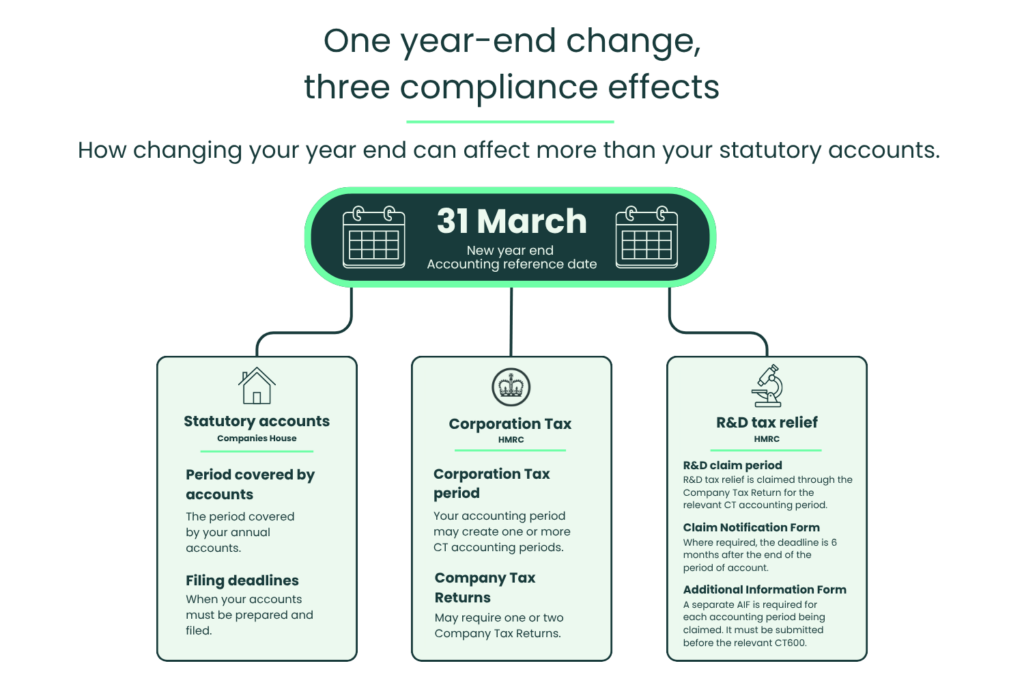
Changing an accounting reference date can affect the period covered by a company’s statutory accounts. It may also affect Corporation Tax accounting periods and related filing requirements. These wider implications should be considered before changing an accounting reference date.
Can a company change its year end?
Yes. Companies can apply to change their year end through Companies House.
While it is flexible, a financial year can generally only be extended up to a maximum of 18 months. This extension is normally permitted only once every five years, unless a statutory exception applies, such as the company being in administration or aligning its dates with a parent or subsidiary company.
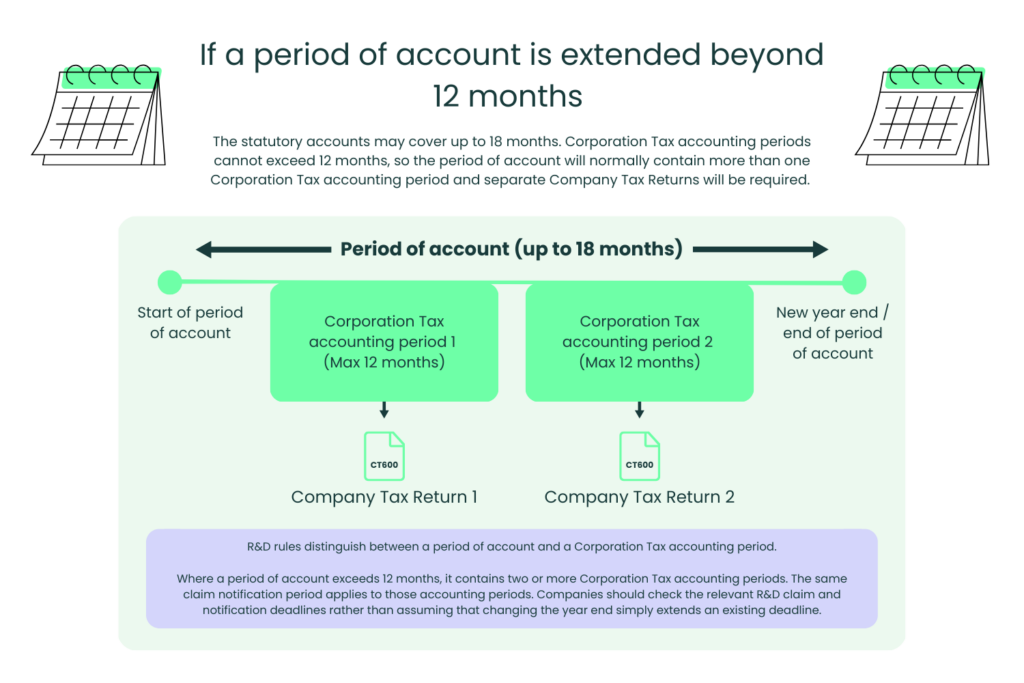
Shortening a financial year is generally more flexible than lengthening, and may be carried out more than once. However, companies must carefully manage how a revised year end affects their deadlines. While Companies House allows an extended financial year of up to 18 months, HMRC Corporation Tax periods cannot exceed 12 months, meaning an extension will require filing two separate tax returns to cover the longer period.
How is a company year end date changed?
A company’s year end, known as its Accounting Reference Date, can be changed through Companies House. The change must be made before the filing deadline for the accounts relating to the period being changed. An accounting reference date cannot be changed if the accounts for that period are already overdue.
Before submitting a request, it is important to understand whether the company intends to shorten or extend its financial year, as different restrictions and filing deadline implications apply.
Shortening a financial year
Companies can shorten a financial year by any number of days and, under the current rules, can do this more than once. This approach is often used to align reporting dates following a group restructure or to choose a year end that better reflects the company’s commercial activity.
Lengthening a financial year
Companies can extend a financial year to a maximum of 18 months. In most cases, this can only be done once every five years unless an exception applies.
Changing a company’s year end will normally also affect its accounting period for Corporation Tax and may alter filing deadlines. A Corporation Tax accounting period cannot exceed 12 months. If the company prepares accounts covering more than 12 months, it will therefore need to file two Company Tax Returns to cover the period.
What are 10 reasons for changing a company year end?
There are many legitimate reasons why companies make the decision to change their year end. The most common commercial reasons include the following:
1. Aligning companies within a group
Groups often choose a common company year end so that all subsidiaries prepare accounts for the same reporting period. This simplifies the preparation of consolidated financial statements and reduces the administrative burden across the group.
2. Reflecting seasonal trading patterns
Businesses in seasonal industries may choose a year end that falls outside their busiest trading period. This can make it easier to allocate staff time to year-end administration and financial reporting without disrupting day-to-day operations.
3. Simplifying stocktakes and inventory management
For businesses that hold physical stock, choosing an accounting reference date when inventory levels are typically lower can make year-end stocktakes and valuation less time-consuming and costly.
4. Aligning with an overseas holding company
Many multinational groups standardise reporting dates across different countries. Aligning a UK subsidiary’s accounting reference date with its overseas holding company can simplify internal reporting and group accounts.
5. Preparing for investment
Where businesses are preparing for investment, changing the date of their year end may help ensure the financial statements cover a more relevant trading period.
6. Preparing for a business sale
Aligning reporting periods during a business sale can simplify the due diligence process and help ensure buyers, advisers and lenders receive financial information that covers a consistent reporting period.
7. Supporting corporate restructuring
Group reorganisations frequently involve transferring businesses, creating new subsidiaries or changing ownership structures. A revised accounting reference date can help align financial reporting following these changes.
8. Reducing administrative complexity
Some companies select a year end that is more suitable for existing finance processes and reporting cycles. This can improve workflow planning and reduce the administrative burden associated with year-end reporting.
9. Aligning with the Corporation Tax financial year
Many companies choose 31 March as their company year end because it aligns with the end of the Corporation Tax financial year. This can reduce the need to apportion profits where Corporation Tax rates change between financial years, making tax computations simpler.
10. Improving budgeting and financial planning
Changing an accounting reference date can help with reviewing annual performance at a point that is more closely aligned with the company’s commercial cycle. This can improve areas such as budgeting, forecasting and strategic planning.
Things to consider before changing an accounting reference date
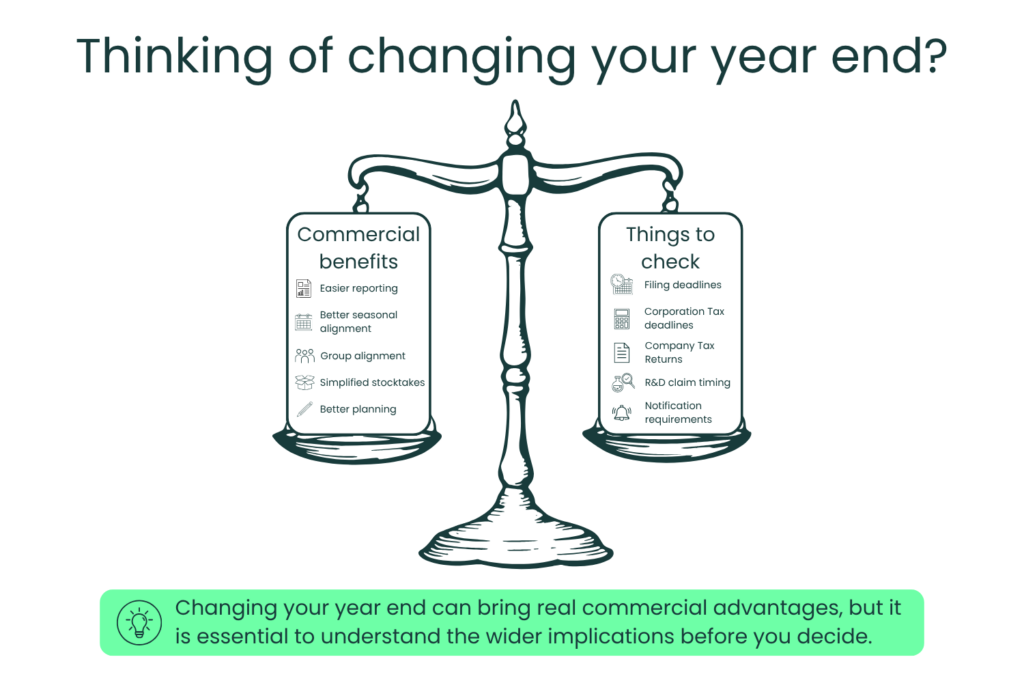
A revised company year end date can influence more than statutory filing deadlines. It may also affect Corporation Tax accounting periods, financial reporting and the timing of other compliance obligations. Companies should also consider whether the new reporting period aligns with their operational activity.
A year end that falls during a busy trading period may increase the administrative burden associated with preparing accounts, carrying out stocktakes and finalising financial information. Choosing a date that better reflects the company’s trading cycle can make the year-end reporting process more efficient.
Where a company forms part of a wider group, any proposed change should also be considered alongside the reporting requirements of parent companies and subsidiaries. From our experience as R&D tax specialists, it’s also worth assessing whether a revised accounting reference date will alter the timing of future R&D tax relief claims, Claim Notification Forms or Additional Information Forms, even though these should never be the primary reason for making the change.
Does changing an accounting reference date affect Corporation Tax?
Yes. Although the accounting reference date is set through Companies House, changing it can alter a company’s Corporation Tax accounting periods.
If the period covered by a company’s accounts exceeds 12 months, it will contain two Corporation Tax accounting periods. This means separate Company Tax Returns will be required, even where a single set of statutory accounts covers the longer period.
Companies should consider how a revised accounting reference date can affect filing deadlines, payment dates and financial reporting obligations before making any changes. The company may also need to update its Corporation Tax accounting period dates with HMRC following a change to its financial year.
Does changing an accounting reference date affect R&D tax relief?
Yes, potentially. By itself, changing an accounting reference date doesn’t make an activity class as genuine R&D or turn otherwise ineligible costs into eligible R&D expenditure. It can, though, affect the timing of an R&D tax relief claim and which Corporation Tax accounting periods qualifying expenditure falls into.
A revised company year end may affect:
- The Corporation Tax accounting periods to which an R&D tax relief claim relates.
- Which Corporation Tax accounting periods qualifying expenditure is allocated to.
- The deadline for submitting an R&D tax relief claim.
- The deadline for submitting a Claim Notification Form, where required.
- The number of Additional Information Forms required.
Where a period of account is extended beyond 12 months, the statutory accounts may cover up to 18 months. Corporation Tax accounting periods cannot exceed 12 months, so the period of account will contain two Corporation Tax accounting periods and separate Company Tax Returns will be required.
If R&D tax relief is claimed for both Corporation Tax accounting periods, a separate Additional Information Form is required for each claim. Each AIF must be submitted before the relevant Company Tax Return.
The rules for R&D claims and claim notification distinguish between a period of account and a Corporation Tax accounting period.
If a period of account exceeds 18 months, the statutory deadline is strictly 42 months from the very first day of that long period of account.
However, for a period of account of 18 months or less, the deadline to claim or amend is 24 months from the end of that period of account.
This deadline applies to the Corporation Tax accounting periods falling within it.
Claim notification is also linked to the period of account. Where a period of account exceeds 12 months and a claim notification is required, you only need to submit one claim notification form to cover all the Corporation Tax accounting periods falling within that extended period. The deadline to submit this form is six months after the last day of the entire period of account.
Companies should therefore check the deadlines that apply to their circumstances rather than assuming that changing the year end simply extends an existing R&D claim window.
An accounting reference date will usually be changed for commercial, accounting or administrative reasons. Any effect on R&D tax relief should be considered alongside the wider Corporation Tax and reporting consequences, rather than treated as the reason for changing the company year end.
Closing thoughts
Changing a year end can support a range of commercial objectives, but the wider implications should always be considered before making a decision. Understanding how a revised accounting reference date affects statutory filing deadlines, Corporation Tax accounting periods and financial reporting can help reduce unnecessary administrative complexity and ensure the new reporting period aligns with the company’s commercial objectives.
At Alexander Clifford, we regularly advise companies on how accounting periods interact with Corporation Tax and R&D tax relief. When considering a change to an accounting reference date, understanding the wider implications can help ensure the decision supports the company’s long-term commercial objectives while remaining compliant with Companies House and HMRC requirements.
To discuss how changing your company’s year end could affect your Corporation Tax accounting periods or the timing of an R&D tax relief claim, please get in touch with our team.