01614578100
 hello@alexanderclifford.co.uk



Making Tax Digital (MTD) for Income Tax is changing how many sole traders and landlords report their income to HMRC. Since 6 April 2026, those with qualifying income of more than £50,000 have been required to keep digital records and submit quarterly updates using compatible software.
This guide explains who needs to use MTD for Income Tax, the key deadlines and what those within scope need to do to prepare.
Who needs to use Making Tax Digital for Income Tax?
Making Tax Digital for Income Tax applies to individuals who receive qualifying income from self-employment, property or both. Whether they need to use MTD depends on their total qualifying income before expenses, rather than their profit.
Since 6 April 2026, individuals have been required to use MTD for Income Tax if the qualifying income was more than £50,000 in the 2024/25 tax year. The threshold will then fall to £30,000 from April 2027, based on qualifying income reported for 2025/26.
From 6 April 2028, the threshold will fall again to more than £20,000, based on qualifying income for 2026/27.
If they have more than one source of qualifying income, these amounts are combined when determining whether the individual exceeds the threshold.
For example, if someone earns £35,000 in gross self-employment income and £20,000 in gross property income, their total qualifying income would be £55,000.
MTD for Income Tax doesn’t apply to limited companies. Companies, including those carrying out qualifying R&D activities or claiming R&D tax relief, continue to report through the Corporation Tax system rather than MTD for Income Tax.
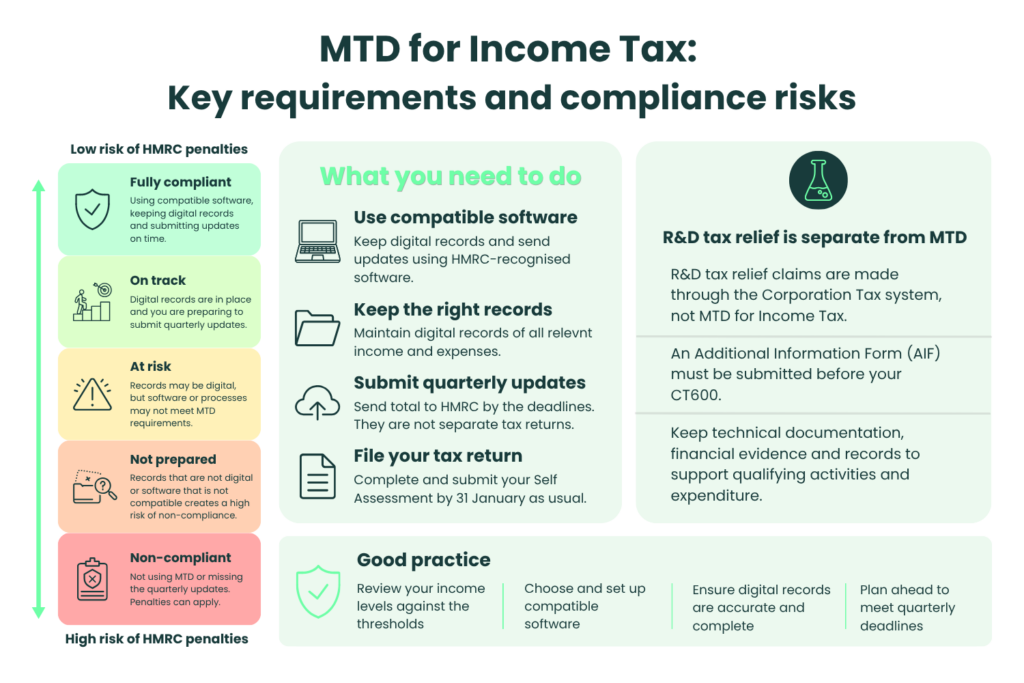
Those required to use this system will generally need to keep digital records and use compatible software to send quarterly updates to HMRC.
What are the MTD quarterly reporting deadlines?
Under Making Tax Digital for Income Tax, those within scope need to send quarterly updates to HMRC using compatible software. These updates contain totals of self-employment and property income and expenses taken from the digital records maintained during the tax year.
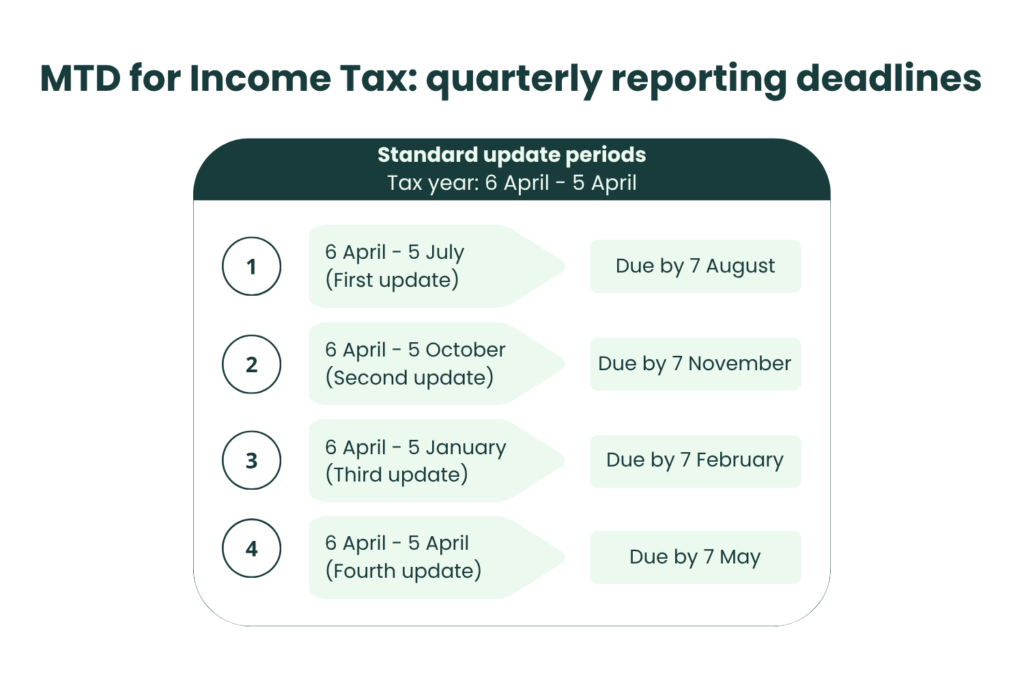
For those using the standard update periods, which align with the tax year from 6 April to 5 April, the deadlines are:
- First update: 6 April to 5 July, due by 7 August
- Second update: 6 April to 5 October, due by 7 November
- Third update: 6 April to 5 January, due by 7 February
- Fourth update: 6 April to 5 April, due by 7 May
It’s worth noting that these updates are cumulative. For example, the second update covers records from 6 April to 5 October, rather than only the period from 6 July to 5 October.
If an accounting period runs from 1 April to 31 March, calendar update periods can be used instead. These run to 30 June, 30 September, 31 December and 31 March. The filing deadlines remain the same: 7 August, 7 November, 7 February and 7 May.
Quarterly updates are not separate tax returns. Individuals within MTD for Income Tax must still complete and submit their Income Tax Self Assessment tax return using compatible software. The deadline remains 31 January following the end of the relevant tax year.
For the 2026/27 tax year, HMRC will not apply penalty points for late quarterly updates.
What records need to be kept digitally?
Under Making Tax Digital for Income Tax, those within scope must create and maintain digital records of their relevant self-employment or property income and expenses using compatible software.
The digital records required will depend on the type of income being reported. They must contain the information required under the MTD rules and be maintained using software that is compatible with HMRC’s system.
Examples of digital information includes:
- Income and expenses: Digital records of qualifying income and expenses required under the MTD rules.
- Quarterly updates: Updates based on the information held in the digital records, submitted to HMRC using compatible software.
- Compatible software: Where different software products are used to maintain records and meet MTD obligations, chosen software setup must meet HMRC’s requirements.
What about records for R&D tax relief?
R&D tax relief operates separately from Making Tax Digital for Income Tax. Companies making an R&D tax relief claim are subject to Corporation Tax requirements rather than the MTD for Income Tax rules.
An Additional Information Form (AIF) must be submitted before the Company Tax Return containing the R&D claim. The AIF requires information about the qualifying R&D activities and expenditure included in the claim. This includes information explaining the advance in science or technology sought, the scientific or technological uncertainties encountered and the work undertaken to resolve them.
Companies should also retain appropriate financial and technical evidence to support the qualifying activity and eligible expenditure included in the claim. Depending on the circumstances, this could include payroll records, invoices, project documentation and calculations or reasonable apportionments used to determine qualifying expenditure.
These supporting records should not be confused with MTD for Income Tax digital record-keeping requirements. HMRC does not impose a general requirement for R&D claimants to maintain digital timesheets or digital receipts specifically for the purpose of making an R&D tax relief claim. The records needed will depend on the activities, expenditure and evidence relevant to the individual claim.
What does this mean for an R&D tax relief claim?
Making Tax Digital for Income Tax and R&D tax relief operate separately. The end of the personal tax year on 5 April does not determine a company’s R&D tax relief claim deadline. R&D claims are made through the Corporation Tax system and are linked to the company’s relevant accounting periods.
For a standard 12-month period of account, the deadline for making an R&D claim is generally 24 months from the end of that period. Where a period of account is longer than 12 months, it is split into separate accounting periods for Corporation Tax purposes. For a period of account of 18 months or less, the deadline for claims relating to those accounting periods is generally 24 months from the final day of the period of account. Different time limits can apply where the period of account exceeds 18 months.
Some companies must also submit an R&D Claim Notification. The notification period generally ends six months after the end of the relevant period of account. This can apply to first-time claimants and companies whose last R&D claim was made more than three years before the last date of the relevant claim notification period, subject to HMRC’s specific exceptions. Where a Claim Notification is required, failing to meet the relevant requirements can make a subsequent R&D claim invalid.
When preparing an R&D claim, companies should review the R&D activities and supporting records relevant to that specific accounting period.
This can include:
- Identifying the advance in science or technology sought and the scientific or technological uncertainties encountered.
- Documenting the qualifying activities undertaken to resolve those uncertainties.
- Reviewing staff costs and any reasonable apportionment of time spent on qualifying activities.
- Identifying eligible expenditure, which may include software, consumables, cloud computing and data licence costs where the relevant conditions are met.
- Checking whether an R&D claim notification is required.
Companies making an R&D claim must also submit the mandatory Additional Information Form (AIF) before they submit the Company Tax Return (CT600) containing the claim.
Clear financial and technical records can help demonstrate how qualifying expenditure was calculated and how the activities included in the claim meet HMRC’s definition of R&D for tax purposes. The technical evidence should show the advance in science or technology sought, the scientific or technological uncertainties encountered and the work undertaken to resolve them.
Does Making Tax Digital affect R&D tax relief?
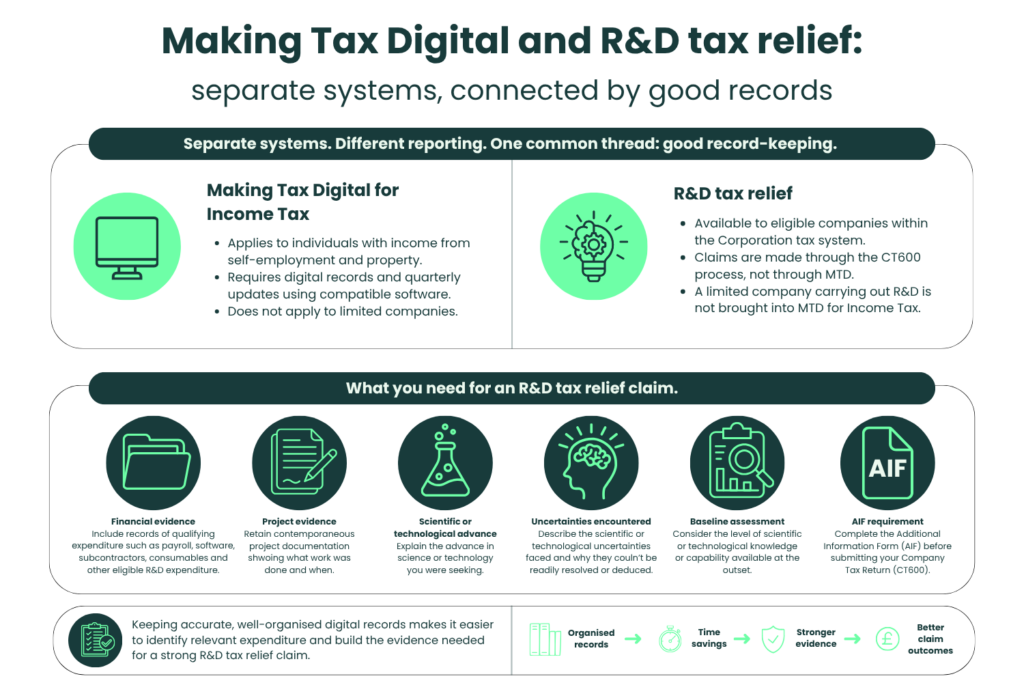
Making Tax Digital for Income Tax and R&D tax relief are separate parts of the UK tax system.
MTD for Income Tax applies to qualifying individuals with income from self-employment and property. R&D tax relief is available to eligible companies within the Corporation Tax system. This means a limited company isn’t brought into MTD for Income Tax simply because it carries out qualifying R&D.
There is still a practical connection between the two: record-keeping. Clear financial and project records can make it easier to identify eligible expenditure and support the preparation of an R&D tax relief claim.
Financial records alone aren’t enough to establish that an R&D project qualifies. A company must also identify the advance in science or technology sought and the scientific or technological uncertainties encountered. The assessment should consider the baseline level of scientific or technological knowledge or capability available in the field and whether the uncertainty could readily be resolved, or its solution readily deduced, by a competent professional working in the relevant field.
Closing thoughts
Making Tax Digital for Income Tax represents a change in how sole traders and landlords keep records and report information to HMRC. Understanding when the rules apply, what information needs to be kept digitally and which software is required can all help prepare for MTD obligations and avoid unnecessary disruption.
While MTD for Income Tax and R&D tax relief operate under separate tax regimes, accurate record-keeping remains a crucial step for both processes. For companies undertaking qualifying R&D, maintaining clear financial and project records can make it easier to identify eligible expenditure and support the preparation of an R&D tax relief claim.
At Alexander Clifford, we specialise in R&D tax relief and help companies identify qualifying activity, assess eligible expenditure and prepare claims in line with HMRC requirements. As tax reporting becomes increasingly digital, having clear and consistent records can also help create a stronger evidence base for R&D claims.
If your company is carrying out work involving scientific or technological uncertainty and you’d like to understand whether it could qualify for R&D tax relief, please get in touch with our team.