01614578100
 hello@alexanderclifford.co.uk



Intellectual Property (IP) ownership can raise questions when a company is preparing an R&D tax relief claim, particularly within a group structure. A common example is where the company carrying out the R&D does not own the resulting IP because it sits with a parent PLC.
Does that prevent the company from claiming R&D tax relief? Not necessarily.
The treatment of IP ownership needs to be considered alongside the wider R&D arrangements, including which company decided to undertake or initiate the R&D, the contractual obligations between the parties, which company incurred the relevant expenditure, and the surrounding commercial circumstances.
This is particularly relevant for accounting periods beginning on or after 1 April 2024, where the rules changed from the previous SME and RDEC schemes that were in place before the Merged and ERIS schemes.
The reformed contracted-out R&D rules apply under both the Merged Scheme and ERIS Scheme. For companies within corporate groups, understanding where the IP sits is only one part of establishing which entity may be entitled to claim.
This article looks at why IP ownership matters, what has changed under the current HMRC R&D tax relief rules, and what HMRC considers when assessing R&D tax relief claims involving group companies.
Why does Intellectual Property ownership matter for R&D tax relief?
Intellectual Property (IP) ownership can be relevant to an R&D tax relief claim, but it isn’t a standalone test of eligibility. A company doesn’t necessarily need to own the IP arising from an R&D project to make a qualifying claim.
Where R&D takes place between group companies, or one company carries out work for another, IP ownership can provide evidence about the commercial relationship between the parties. It may help explain what was agreed, which company controlled or funded the work, and what the parties intended when the relevant contract was entered into.
Under the reformed contracted-out R&D rules, the central question isn’t simply who owns the resulting IP. The contractual terms and surrounding circumstances must be considered to establish whether R&D was contracted out and which company may be entitled to claim.
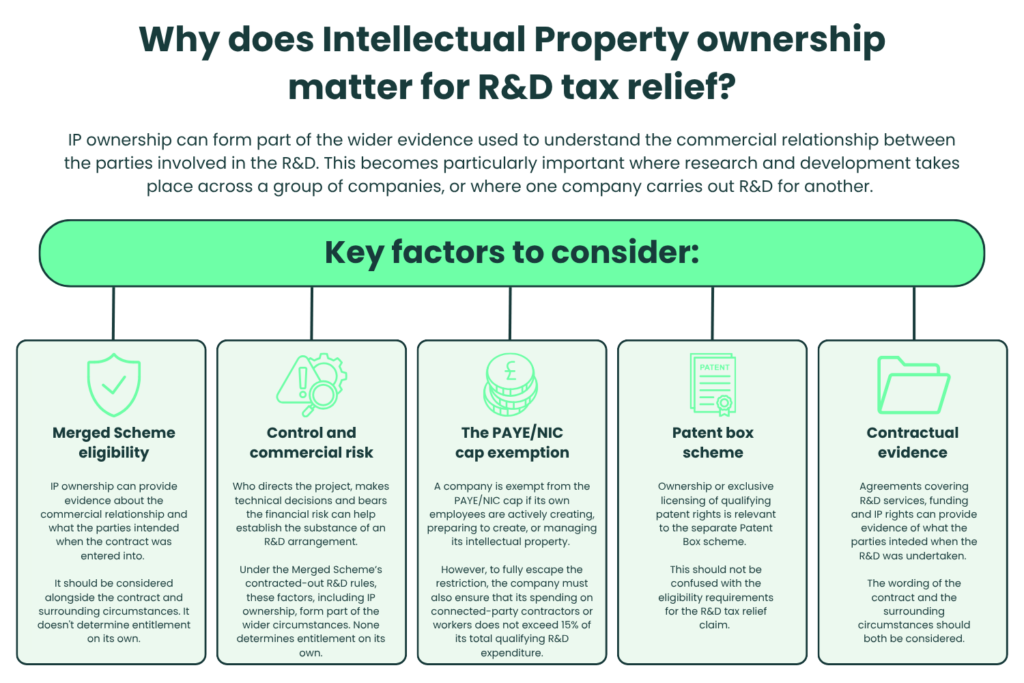
Factors to consider include:
- Determining eligibility under the Merged Scheme:
IP ownership can provide evidence about the commercial relationship between the parties and what they intended when the relevant contract was entered into. Where the contracted-out R&D rules apply, this needs to be considered alongside the contractual terms and surrounding circumstances, including whether the customer intended or contemplated that R&D of that sort would be undertaken. IP ownership does not determine entitlement on its own.
- Understanding control and commercial risk:
The right to direct a project, make technical decisions and bear the financial consequences can help establish the substance of the arrangement. IP ownership may support this assessment, but it shouldn’t be considered on its own. Under the Merged Scheme’s contracted-out R&D rules, these factors form part of the surrounding circumstances rather than determining entitlement on their own.
- The PAYE/NIC cap exemption:
The PAYE/NIC cap does not apply where both statutory conditions are met. Broadly, the first concerns the company creating or preparing to create relevant IP, or carrying out significant management activities in relation to relevant IP that it holds, with those activities undertaken wholly or mainly by its employees. The second limits qualifying expenditure on connected-party contractors and externally provided workers to 15% of total qualifying R&D expenditure.
- Patent Box:
Ownership or exclusive licensing of qualifying patent rights is relevant to the separate Patent Box regime. This shouldn’t be confused with the eligibility requirements for R&D tax relief.
- Contractual evidence:
Agreements covering R&D services, funding and IP rights can provide evidence of what the parties intended when the R&D was undertaken. The wording of the contract and the surrounding circumstances should both be considered.
For companies within a PLC group, this distinction matters. The fact that IP is held centrally by a parent company doesn’t automatically mean that a subsidiary carrying out qualifying R&D activity is unable to claim. The contractual arrangements and the specific R&D tax relief rules still need to be considered.
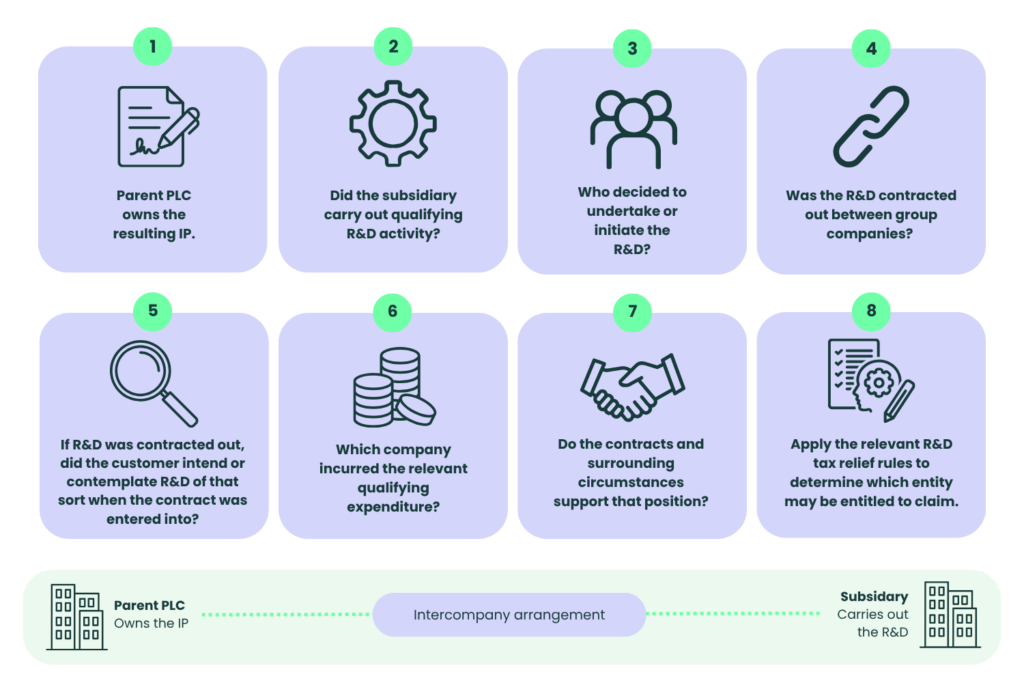
Can a company claim R&D tax relief if its parent PLC owns the IP?
Yes. Parent company ownership of Intellectual Property does not automatically prevent a subsidiary from claiming R&D tax relief, as legal ownership of the resulting IP is not a primary statutory test for entitlement under UK tax law set by HMRC.
The relevant question is whether the subsidiary satisfies the conditions of the applicable R&D tax relief rules. Where R&D is undertaken under an intercompany arrangement, this includes considering whether the R&D was contracted out, which company decided to undertake or initiate it, what the customer intended or contemplated when the contract was entered into, and which company incurred the relevant qualifying expenditure. HMRC views IP ownership merely as circumstantial evidence pointing to the intentions of the parties rather than a disqualifying factor.
Before making a claim, the arrangements between the companies should be reviewed, including:
- Which company decided to undertake or initiate the R&D
- What R&D activity each party expected or had in mind when the relevant contract was entered into
- The contractual obligations between the parent and subsidiary, paying close attention to who bears the ultimate financial risk
- Which company incurred the relevant expenditure
- Whether the R&D was contracted out between group companies
- How the surrounding circumstances support what the parties intended or contemplated
There are also specific provisions allowing two group companies to make an election in certain contracted-out R&D circumstances. This can affect which company is treated as eligible to claim. Under CTA 2009 s1142(5), two group companies can make a revocable joint election in relation to R&D contracted from one group company to another.
Broadly, the election can alter the normal treatment of contracted-out R&D between the two group companies so that relief may be available to the contractor company, subject to the statutory conditions. This allows the performing contractor company to remain eligible for relief even if the normal rules would initially assign the claim to the commissioning parent company.
So, parent ownership of the IP isn’t an automatic barrier to R&D tax relief. The wider facts determine the position, particularly which company decided to undertake or initiate the R&D, whether the customer intended or contemplated R&D of that sort, and the contractual relationship between the group companies.
What does HMRC look at besides Intellectual Property ownership?
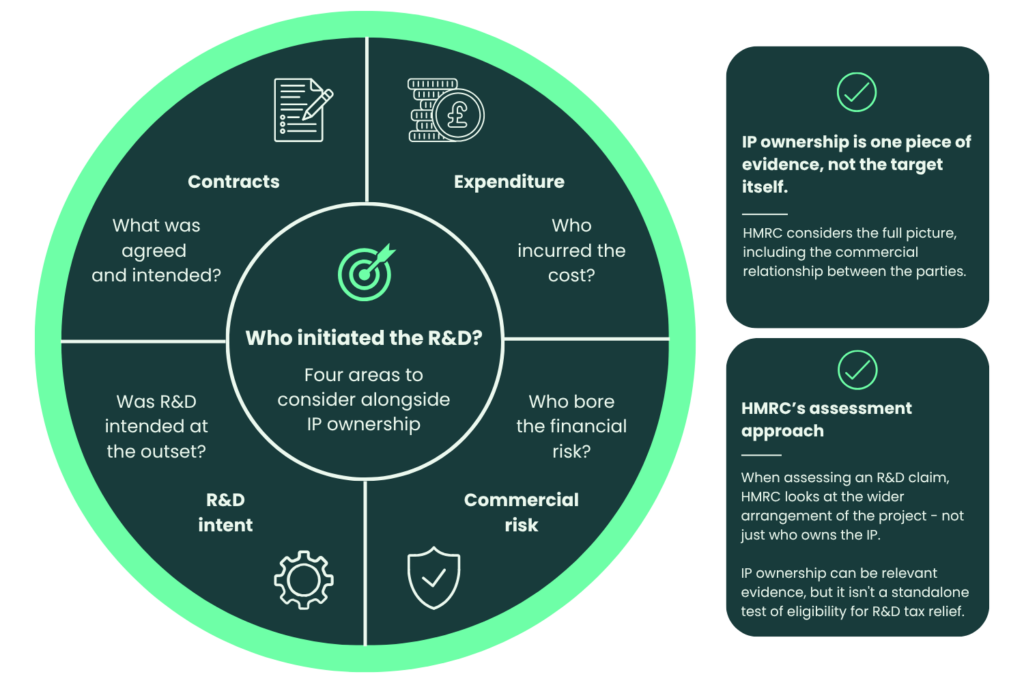
Besides IP ownership, HMRC will look at the wider circumstances surrounding the R&D. This includes the contractual relationship between the companies and the surrounding circumstances.
For accounting periods beginning on or after 1 April 2024, one of the main questions is which company decided to undertake or initiate the R&D. Where R&D is contracted out, HMRC also considers whether it is reasonable to assume that the customer intended or contemplated that R&D of that sort would be undertaken when the contract was entered into. Simply having a vague awareness that R&D might be required is not enough.
HMRC may consider the following:
Who initiated the R&D?
Which company decided that the R&D should be undertaken, and what R&D did each party intend or contemplate when the contract was entered into?
HMRC will also consider the status of the customer. Specific rules can allow a contractor to claim where R&D is contracted out to it by an ineligible company, such as a charity or institution of higher education, or where the customer contracts out the R&D otherwise than in the course of a trade, profession or vocation within the charge to tax.
What does the contract say?
Was the subsidiary specifically contracted to carry out R&D, or was it engaged to deliver a product, service or other commercial outcome?
Was R&D contemplated by the customer?
HMRC considers whether it is reasonable to assume that the customer intended or contemplated that R&D of that specific sort would be undertaken when the contract was entered into.
Where R&D of that sort was not intended or contemplated by the customer when the contract was entered into, the contracted-out R&D provisions may produce a different outcome. The particular facts and statutory conditions need to be considered rather than assuming that any unexpected R&D automatically belongs to the contractor for claim purposes.
What happened in practice?
The contractual wording is important, but HMRC can also consider the surrounding circumstances when establishing what the parties intended or contemplated.
Who incurred the qualifying expenditure?
The company making the claim must have incurred expenditure that meets the conditions of the relevant R&D relief.
Under the reformed rules, the previous SME subsidised expenditure restrictions no longer determine the position. Instead, the contracted-out R&D provisions require the contractual terms and surrounding circumstances to be considered when establishing which party can claim for the relevant R&D.
Companies must also comply with the relevant claim requirements, including submitting an Additional Information Form and, where required, notifying HMRC of their intention to claim within the applicable notification period.
What should companies in a PLC group consider when making an R&D claim?
For companies within a PLC group, the first step is identifying which legal entity is entitled to make the R&D claim. This can become less straightforward where technical staff, funding and expenditure sit across different group companies, or where costs are recharged between entities.
Key points to consider include:
- Who initiated the R&D
- Intercompany costs
- Overseas expenditure
- Claim requirements
- Filing requirements
The supporting technical information should explain the advance sought, the scientific or technological uncertainties encountered, and the work undertaken to resolve them.
Closing thoughts
IP ownership can be relevant when assessing an R&D tax relief claim, but it does not determine eligibility on its own. Where IP is owned by a parent PLC or another group company, the wider arrangement must be considered.
For companies within PLC groups, these arrangements become more complex when R&D activity, funding, employees, and IP sit across different legal entities. The introduction of the Merged Scheme also means that assumptions based on the previous SME and RDEC rules may no longer reflect current contracted-out R&D rules.
At Alexander Clifford, we focus solely on Research and Development tax credits. We assess the technical basis of a claim alongside eligible expenditure, analyzing how contractual and group arrangements affect which company is entitled to claim. Our role is to help businesses prepare robust R&D claims based on qualifying activity and eligible expenditure, fully supported by the appropriate technical information and aligned with current legislation.
If you would like to discuss an R&D tax relief claim involving a PLC group, contracted-out R&D or IP held by another group company, please don’t hesitate to get in touch.