01614578100
 hello@alexanderclifford.co.uk



Innovate UK is the UK’s national innovation agency. It provides funding to support business-led research and development projects across a range of industries. Businesses can apply for grants, with funding levels varying by competition.
Through these funding competitions, Innovate UK aims to accelerate innovation, support economic growth, and encourage the commercialisation of new technologies. Funding is typically awarded to projects that demonstrate clear technical innovation and a credible route to market.
Grants range from early-stage feasibility funding to larger collaborative projects. For example, Innovate UK typically funds between 50% and 67% of eligible project costs, depending on the size and structure of the organisation.
This guide explains what Innovate UK is, the types of projects that qualify for funding, and how the application process works in practice.
What is Innovate UK?
Innovate UK is part of UK Research and Innovation (UKRI). It is the UK’s national innovation agency and is mostly recognised for granting financial support to innovative businesses.
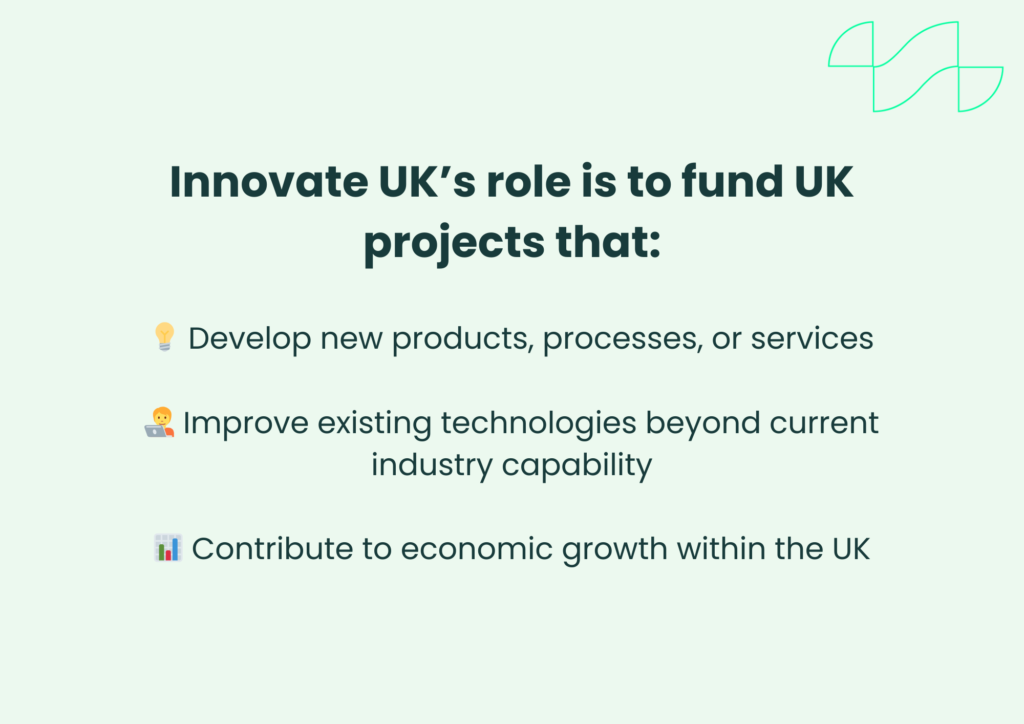
Innovate UK funding was introduced to financially support and accelerate research and development activity, rather than to subsidise routine commercial activity. Funding is typically awarded through competitions focused on areas such as artificial intelligence, advanced manufacturing, life sciences, clean energy, and digital technologies.
These projects must be able to achieve an advance in science or technology through the resolution of scientific or technological uncertainty. For example, a business must be able to clearly demonstrate the attempt to create a new product or service where the outcome is not readily resolvable by a competent professional.
What type of projects are eligible for Innovate UK grants?
Eligibility for Innovate UK funding is determined by the specific requirements of each competition. However, there are some common characteristics that most successful projects share.
Focus on innovation
Projects must demonstrate a clear and evidenced element of innovation. This does not require the idea to be entirely new, but it must represent an advance beyond the current industry standards.
For example, a project may:
- Develop a new software platform with improved technical capability
- Create a more efficient manufacturing process
- Apply existing technology in an innovative way to solve a technical problem
Projects that involve routine development or incremental change without meaningful scientific or technological uncertainty are unlikely to be competitive.
Presence of technical uncertainty
One of the main requirements listed in the criteria is the presence of technical uncertainty.
This means that:
- The outcome cannot be readily determined using existing knowledge
- A competent professional in the field would need to undertake investigation or experimentation to resolve the uncertainty
- The project involves genuine scientific or technological uncertainty
This also aligns with HMRC’s definition of qualifying R&D activity. If a project already has a known solution or relies on standard implementation, it is unlikely to meet the criteria for Innovate UK funding.
Commercial potential
Innovate UK places strong emphasis on the economic impact and commercial viability of the businesses submitting their projects for funding.
Applications must demonstrate:
- A clear route to market
- Evidence of demand or commercial need
- The potential for scalability or growth
The funding is intended to support innovation that leads to productivity, UK-based growth, and economic impact. Projects that lack a clearly defined and evidenced commercial outcome, a justified need for funding, and a well-structured delivery plan are unlikely to receive funding from Innovate UK.
Project structure and planning
Applications for Innovate UK grants are assessed on the quality of planning and delivery.
The application must include:
- A clearly defined scope of the project
- Realistic timelines and milestones
- A capable team working on the project with the relevant expertise
In areas where the project involves collaboration, the roles and responsibilities of each partner must be clearly defined and evidenced.
Eligible sectors
Innovate UK funding is available across a variety of industries.
Common sectors include:
- Software and digital technology
- Engineering and manufacturing
- Artificial intelligence and data science
- MedTech
- Clean energy and sustainability
Eligibility is not determined by the sector alone. The deciding factor is whether the project meets the criteria for innovation and technical uncertainty.
How to apply for Innovate UK grants
The application process is a structured and very competitive process. The success of the application heavily depends on the quality of the project and the clarity of the supporting evidence provided.
- Identifying a relevant competition
Innovate UK funding is delivered through competitions. These competitions are listed on the UKRI funding portal.
Each competition sets out the following:
- The scope of eligible projects
- Funding limits and rates
- Application deadlines
- Assessment criteria
Selecting the right competition is an important first step. Projects must closely align with the stated objectives of the competition.
- Developing the project proposal
The application requires a detailed proposal that will explain the commercial aspects of the project and evidence of how the project is both technically feasible and commercially viable.
Key components of the proposal include:
- Project description
- Technical approach
- Market opportunity
- Project plan
- Team capability
- The structure of costing and funding
Applicants must provide a clear and detailed breakdown of project expenditure.
An expenditure breakdown typically includes:
- Staff costs
- Subcontractor costs
- Equipment and materials
- Overheads
Innovate UK funding usually contributes a percentage of project expenditure, with the balance funded by the company or its partners.
Accuracy of expenditure is important. Overstated or unclear costs may weaken the application.
- Submit the application
The next step is to submit the application through the UKRI online application system.
The application requires the business to:
- Complete structured application questions
- Upload supporting documentation
- Confirm compliance with eligibility requirements
There are firm deadlines for submission. Late submissions will not be accepted.
- Assessment process
Innovate UK applications are reviewed by a group of independent assessors with relevant technical and commercial expertise.
The assessment criteria typically include:
- Innovation and technical merit
- Commercial potential
- Project execution
- Value for money
Scores are assigned based on the criteria. Innovate UK funding is awarded to the highest scoring applications.
- Project delivery and monitoring
The successful applicants will be contacted by Innovate UK and asked to enter a formal grant agreement. The process of the grant agreement will begin with a conditional grant offer letter to fill out.
Projects are monitored throughout delivery to ensure compliance is maintained.
This may involve:
- Regular progress reporting
- Financial reporting and cost verification
- Evidence that project milestones are being met
Funding is usually paid in stages, linked to project progress.
What are some common challenges in Innovate UK applications?
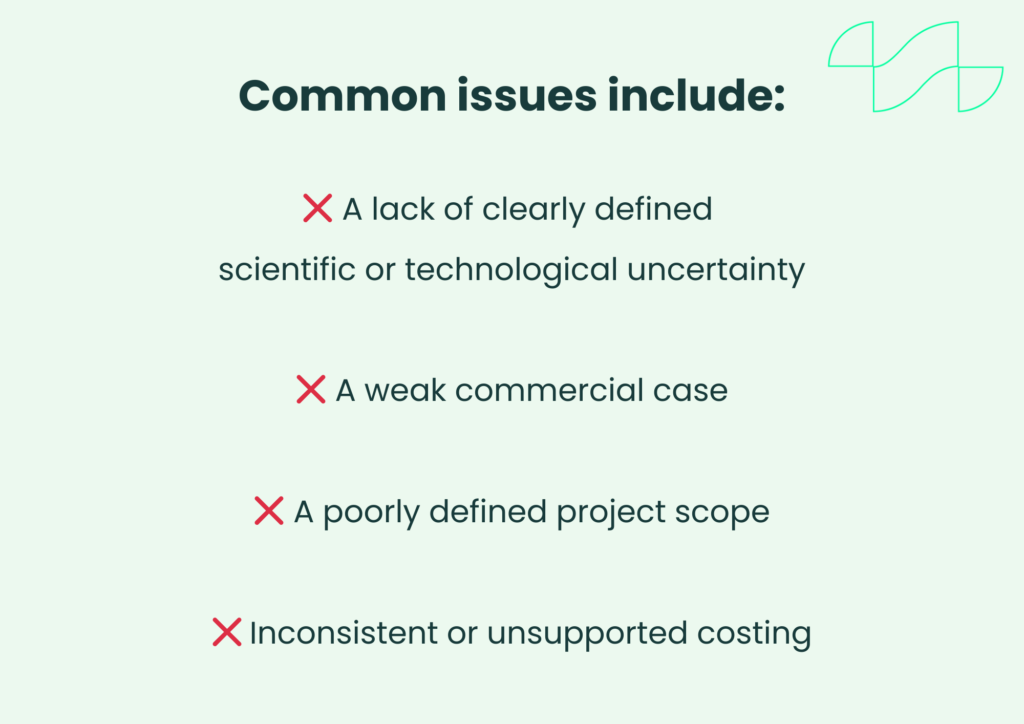
Many applications fail because the proposal does not clearly address the assessment criteria rather than due to the project lacking technical or commercial value.
What is seed funding?
Seed funding supports early-stage businesses that are developing innovative technologies typically before commercial traction or revenue has been established.
Seed funding is typically used for:
- Developing initial prototypes
- Validating technical feasibility
- Building early-stage products or services
- Preparing for further investment or commercialisation
Unlike grant funding, seed funding is usually provided in exchange for equity. This means that the investor takes a stake in the business rather than providing non-dilutive funding.
What is the difference between R&D tax relief and Innovate UK funding?
Innovate UK funding and R&D tax relief both support companies undertaking research and development activity. However, they operate in different ways and are accessed at different stages of the innovation process.
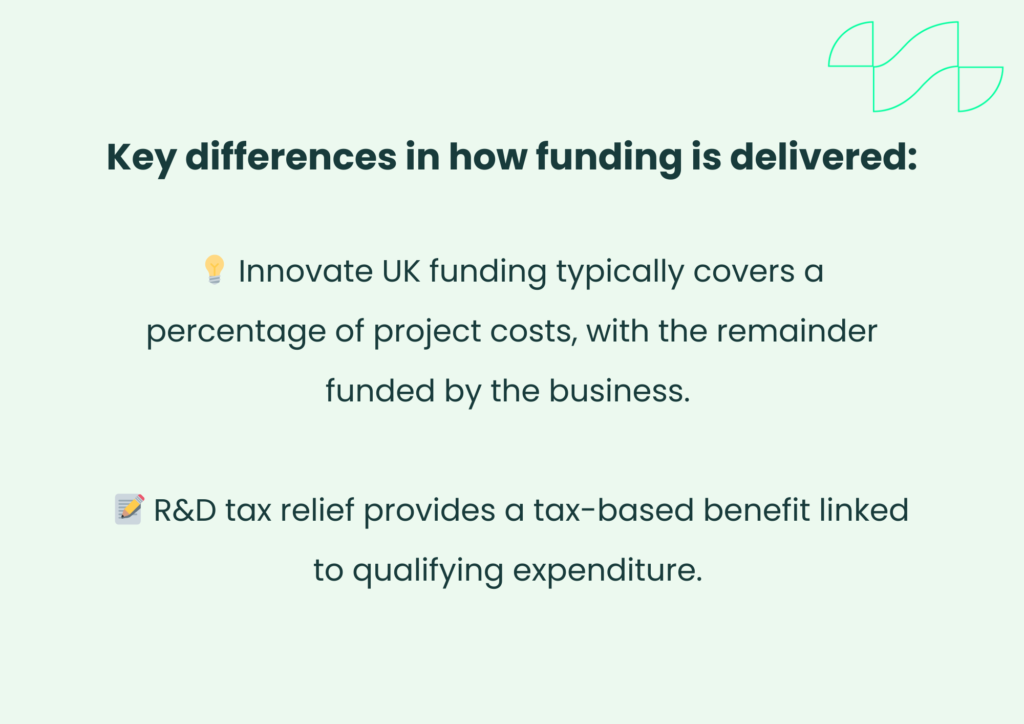
Innovate UK funding is a grant that is provided through a competitive application process. Companies apply to specific competitions and must clearly demonstrate technical innovation, commercial potential, and a clear project plan. The funding can be awarded before or during the project.
On the other hand, R&D tax relief is claimed through the Corporation Tax system. Companies must identify qualifying R&D activity and submit a claim to HMRC within two years of the end of the relevant accounting period.
It is important to understand how each type of financial incentive is awarded. Innovate UK grants are competitive, meaning only the top-scoring applications receive funding. Whereas, R&D tax relief is not competitive. Any company that meets HMRC’s eligibility criteria for qualifying activity and eligible expenditure can submit a claim.
Companies can benefit from both forms of support. However, where a project is grant-funded, the treatment of subsidised expenditure must be taken into account, as this can affect how R&D tax relief is calculated.
When might Innovate UK funding be relevant for companies?
Innovate UK funding is particularly relevant for businesses that:
- Are developing new or improved technologies
- Require R&D to support the early stages of the development process
- Can clearly demonstrate both technical innovation and commercial viability
- Can commit time and resources to an in-depth application process
Given the competitive nature of Innovate UK funding, a well-prepared application, supported by clear and accurate documentation, is essential.
Closing thoughts
An Innovate UK grant provides businesses with structured financial support for funding innovative projects across the UK. The application process is detailed and competitive. Applications that perform well clearly articulate both the technical challenges and the commercial opportunity.
At Alexander Clifford, we support companies in identifying and documenting qualifying R&D activity in line with HMRC guidance.
We have worked with businesses across the UK that have received Innovate UK funding and have also been eligible to claim R&D tax relief, where the underlying projects meet the criteria for qualifying activity.
A structured review can help determine how grant-funded projects interact with R&D tax relief and ensure that claims are prepared on a consistent and supportable basis. If you have any questions or concerns regarding an R&D tax relief claim, get in touch.