01614578100
 hello@alexanderclifford.co.uk



It’s well known that the agricultural industry relies on research and development to ensure food security and adapt to changing climates. What many businesses don’t realise is that these innovative efforts may qualify for R&D tax credits in agriculture.
In the UK, R&D tax relief isn’t confined to a laboratory or high tech industries. It also applies to farming, forestry, fishing and agricultural R&D activities where progress is made through hands on problem solving. And if your work involves innovation that aims to overcome uncertainty, improve efficiency or develop new techniques, you may have an eligible R&D claim.
This article takes a look at five innovative areas of agricultural research and development to highlight where genuine R&D is taking place and why it matters. We’ll also cover the costs that can be claimed, qualifying activities, and why R&D tax credits are becoming an increasingly valuable tool for agricultural advancement.
The role of R&D in modern agriculture
Agriculture is currently facing an array of situations beyond its control. For instance, farmers and businesses are currently navigating:
- Rising input costs
- Unpredictable weather patterns
- Labour shortages
- Sustainability pressures
This has encouraged the industry to shift into ongoing research and development practices that face challenges head on, and produce effective solutions. While there are some trends in agricultural R&D (sustainable and resilient farming practices, advancing precision farming tools, reducing reliance on chemical inputs), constant innovation is what’s keeping the industry stable.
5 innovative agricultural R&D activities that could qualify for R&D tax credits
HMRC is very clear about the qualifying criteria for R&D tax credit relief. While a qualifying project must aim to overcome a scientific or technological uncertainty, qualifying activities assess the following:
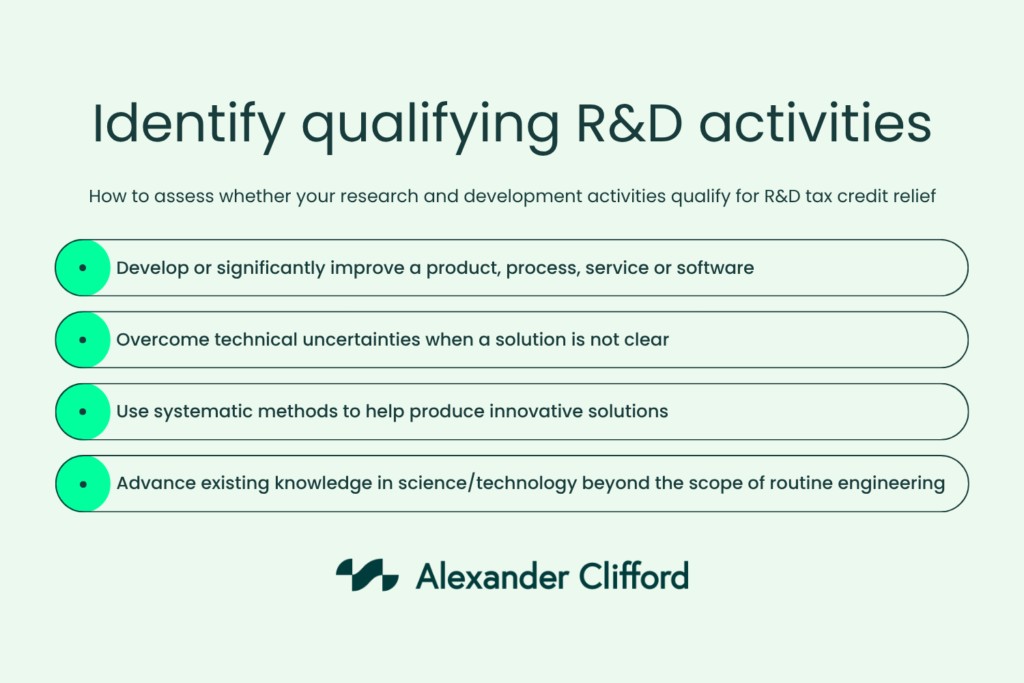
When it comes to research and development in agriculture, there are many areas that encompass these qualifying activities.
Below are some of the areas where agricultural innovation is thriving, and where your work may already meet the qualifying criteria for R&D tax credits.
1. Precision agriculture and data driven farming
Precision agriculture is rocking traditional farming practices by transitioning into highly targeted, data led strategies. With up and coming technology such as GPS mapping and AI powered analytics, farmers are able to monitor crops in real time, allowing them to monitor and respond to changing conditions in real time.
Alongside the development of these technologies is the challenge of making the data actionable. Farms operate in some of the most versatile conditions where soil, weather patterns and crop performance can contrast across a single field.
So even though these tools are becoming increasingly accessible, refining them to fit real world farming environments requires testing, which is a strong indicator of qualifying R&D tax credit activities in agriculture.
Qualifying activities in data driven farming may include:
- Developing or adapting crop management systems (to track growth, disease risk, nutrient levels etc.)
- Integrating various data sources (i.e. weather data, satellite imagery, soil sensors)
- Developing predictive models (to improve crop yield forecasting and reduce waste)
- Testing variable rate applications (for pesticides, fertilisers, irrigation etc.)
More often than not, smart farming technology isn’t about creating something new. The research and development that goes into it is an attempt to improve how existing technologies perform in the complex real world of farming.
2. Regenerative agriculture and soil innovation
Soil behaves differently because of the climate, the type of crop, and how the land was used in the past. Regenerative agriculture is a way to fix soil problems by making the soil healthier and restoring the natural environment.
Soil is like a living thing that can be unpredictable when it is in a place, so those who want to make crops stronger and improve the soil usually look at the living things in the soil and try to develop new ways to improve health. This is called soil microbiology research and microbial inoculant development (microbiome & soil microbiology) which is all about the tiny living things in the soil.
Some qualifying R&D activities in regenerative agriculture and soil innovation include:
- Developing and testing microbial inoculants (to improve crop health and soil fertility)
- Testing cover crop combinations (to improve carbon retention and soil structure)
- Experimenting and measuring the long term impact of zero tillage systems
- Refining organic fertilisation strategies (to reduce synthetic inputs)
Regenerative agriculture is about both science and practical application, so some companies might work together to improve the sustainability of soil. When it comes to research and development, this collaborative approach can qualify for R&D tax credit relief, but it requires distinct agreements that define which business is overseeing the project.
3. Autonomous machinery and agricultural robotics
One of the biggest challenges that the agricultural sector faces right now is access to labour. This is why automation and agricultural robotics are becoming very important for farming.
Agricultural robotics can do a lot more than that though. Autonomous machinery and agricultural robotics are making farming more efficient and precise, by using a combination of data and practical implementation to work in complicated environments.
Farms across the UK combine uneven terrain with unpredictable weather patterns and biological components. This means that developing autonomous farming equipment takes extensive testing and refinement to ensure its capabilities across all landscapes.
Qualifying R&D activities in autonomous machinery and agricultural robotics may include:
- Developing navigation and guidance systems
- Creating real time obstacle detection and safety mechanisms
- Adapting machinery to different crops and terrain
- Integrating robotics with existing smart farming technology
A lot of the work that goes into making new agri-tech innovation involves solving difficult engineering problems. This requires experimentation from the idea stage to actual field testing. Therefore businesses in the UK that invest in machinery and agricultural robotics may be eligible for R&D tax credits for their research and development work.
4. Biotechnology, gene editing and genomics trials
Biotech doesn’t just belong to the medical industry. In fact, biotechnology in agriculture is altering crop performance and resilience across the UK. Using gene editing and genomic trials, researchers and businesses alike are aiming to develop crops that are invulnerable to disease, and that can adapt to extreme climate changes.
The problem is, working with genetics is fickle. Slight alterations to a crop’s genetic make up can have wildly unexpected results. On top of that experimentation needs to continue over multiple growing cycles, so that researchers can assess productivity across various crop generations.
Some of the main qualifying activities for agricultural biotechnology, gene editing and genomics include:
- Using genomic trials to identify specific traits (yield, resilience, or disease resistance)
- Developing environmentally tolerant gene edited crops
- Optimising nutrient intake by using nitrogen use efficiency (NUE)
- Testing genetic performance in various conditions (climate, soil, farming systems)
Research and development in agricultural biotech, gene editing and genomics often involve a significant amount of trial and error. For instance, a genetically altered crop may perform well in controlled conditions, only to respond differently in field conditions.
These experiments often have real world applications that directly involve overcoming scientific uncertainties. Therefore, businesses that oversee research and development in biotechnology, gene editing and genomics are often eligible for R&D tax credits.
5. Smart irrigation systems and water management
Water is a lifeforce in agriculture, but as the shifting climate causes water shortages, it’s more important than ever to invest in efficient irrigation and water management to maintain crop quality.
Unlike traditional irrigation methods, smart irrigation systems are using real time data and automation to distribute water. By measuring soil moisture and weather conditions, they are more than capable of efficiently hydrating crops. This however, requires frequent adaptation of the technology to refine the systems capabilities.
Common qualifying R&D activities for smart irrigation systems and water management include:
- Developing systems that automatically adjust to real time field data
- Integrating sensors (to optimise water usage)
- Testing system performance (across different environments)
- Assessing ways to reduce water waste while maintaining crop yield
A lot of the challenges researchers face in this area of agriculture surround responsiveness and accuracy. For instance, a smart irrigation system deciding how much water to distribute and when can change on a daily basis.
So while the systems are already being implemented throughout the UK, they are still in their infancy and require a range of research and development that could qualify for R&D tax credit relief.
What costs can be claimed for agricultural R&D activities?
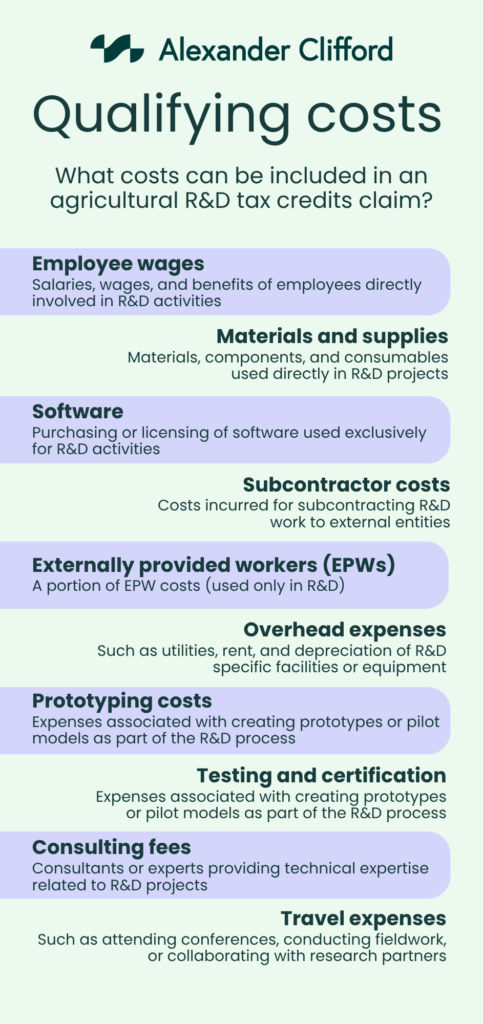
After knowing whether or not you qualify, understanding your expenses is the most important part of your R&D tax credit claim. The following infographic details the research and development costs that can be filed in a claim:
Why R&D tax credits are valuable for the agricultural industry
While the agricultural industry is facing intense climate changes, poor soil health and water shortages, agricultural innovation is no longer optional…it’s necessary. As businesses are being pressured to do more to advance the science and technology in agriculture, many are faced with operating on tighter margins.
Whether a business is investing in developing a new technology or testing sustainable farming methods, research and development requires a significant amount of time and resources. This sets the price of scientific and technological advancement pretty high.
That’s where R&D tax credits really can provide relief by offsetting the cost of innovation.
In agriculture, not every research and development project is going to be successful. When businesses are investing their own resources this can drastically increase the risk, meaning many projects die before they even get off the paper. But for UK businesses, the R&D tax credit relief ensures that even unsuccessful projects can claim their qualifying costs.
This encourages more experimentation and therefore, more progress in agricultural development. By supporting research and development in agriculture, R&D tax credits help to:
- Strengthen sustainable farming innovation efforts
- Expand the use of new technologies
- Support smaller farms and agri-businesses
- Improve global competitiveness
So R&D tax credits in agriculture aren’t just a financial incentive. They’re building the groundwork for an adaptive industry that continues to produce in the face of environmental change.
How to identify if your farming activities qualify for R&D tax relief
To identify eligible R&D tax credit activities in agriculture, it’s important to understand how HMRC defines research and development. The following is an exact quote of their definition:
“R&D for tax purposes takes place when a project seeks to achieve an advance in science or technology […] The activities which directly contribute to achieving this advance in science or technology through the resolution of scientific or technological uncertainty are R&D.”
So your research and development likely qualifies for R&D tax credits if it involves:
- Testing crop varieties, techniques or systems with uncertain outcomes
- Modifying machinery, processes or inputs to improve performance
- Experimenting with soil, irrigation methods or other sustainability efforts
- Developing or adapting technology for real farming applications
Start your R&D tax credit claim
If you’ve finished reading this article and you think that your research and development project might qualify for R&D tax relief, we want to talk to you about what comes next.
At Alexander Clifford, our team helps businesses around the UK to prepare R&D claims that are clearly presented and technically accurate. Our focus is on accuracy and compliance, so you can be certain that your claim aligns with HMRC’s guidelines.
Whether you’re ready to start your claim or you have a few questions about making an R&D claim, feel free to contact us and speak with the Alexander Clifford team.