01614578100
 hello@alexanderclifford.co.uk



Many businesses across the UK undertake qualifying research and development activities without realising they may be eligible for R&D tax relief. For companies making their first R&D claim, the process involves more than simply completing a Corporation Tax return. Businesses need to determine whether their projects qualify, identify eligible expenditure, prepare supporting technical evidence and complete several administrative requirements before submitting their claim to HMRC.
One of the most important requirements is establishing whether a Claim Notification Form (CNF) is needed. For many first-time claimants, this must be submitted within six months of the end of the period of account.
Does your business qualify for R&D tax relief?
When it comes to the qualifying criteria, companies must carry out a project that seeks an advance in science or technology by resolving scientific or technological uncertainties. Common categories of qualifying expenditure include staff costs, consumable items, software licences, certain cloud computing and data licence costs, and, where the legislation permits, qualifying subcontractor or externally provided worker costs.
The core qualifying criteria is simple:
- UK corporation tax: The company must be registered as a limited company liable for UK corporation tax.
- Scientific or technological advance: The company must undertake a project that seeks an advance in science or technology. The advance must extend the overall knowledge or capability within the relevant scientific or technological field.
- Overcoming uncertainty: The company must be able to evidence scientific or technological uncertainty where a competent professional cannot easily resolve it.
Step 1: Identify your qualifying R&D projects
The first step of identifying qualifying R&D projects for companies who have not claimed before will involve them to assess each project against the legislative requirements and HMRC’s published guidance.
For project activities to qualify under the R&D tax relief rules, there must be clear evidence of an attempt to overcome scientific or technological uncertainty.
Before progressing with a claim, businesses should establish whether they are required to submit a Claim Notification Form. Companies that have not claimed R&D tax relief in any of the previous three accounting periods will often need to submit a CNF within six months of the end of the relevant accounting period.
Key tests for this first step is:
- Aiming to create or improve a product, process or service within the scientific or technological field.
- The project must seek an advance beyond what is readily deducible by a competent professional working in the relevant scientific or technological field.
- There must be an uncertainty that a competent professional in the scientific or technological field cannot easily solve using existing knowledge or standard methods.
- Companies must be able to show that they have used a planned process of testing, trialing and iterating to find a solution to the uncertainty.
Step 2: Identify your eligible expenditure
Next, the business will move onto identifying and processing qualifying R&D expenditure. This second step will consist of gathering and categorising eligible R&D costs and applying them to the qualifying R&D projects.
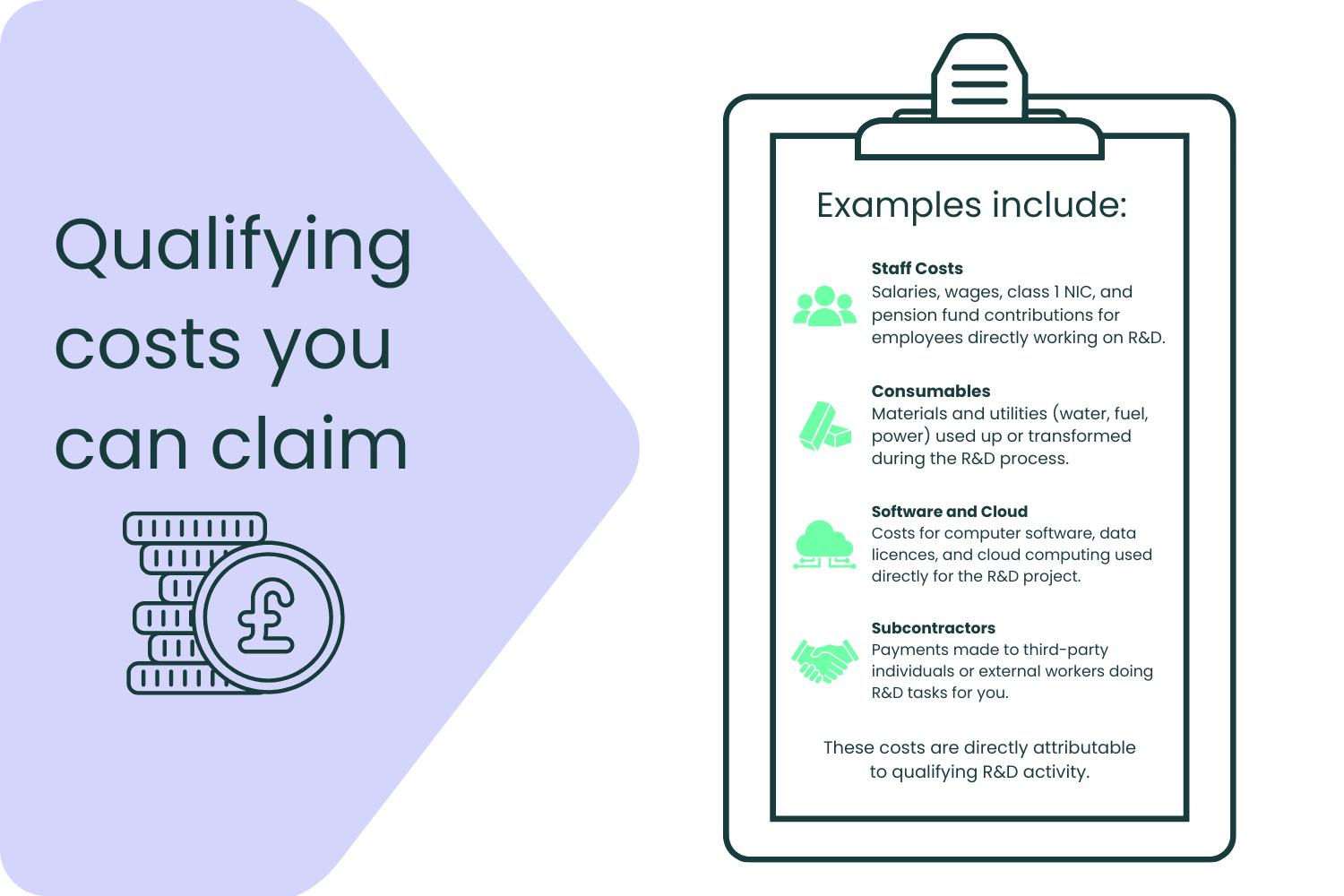
Common qualifying expenditure categories include:
- Staff costs
- Consumables
- Software and cloud
- External workers and subcontractors
There are actionable rules for first-time claimants, these are:
- HMRC prerequisites
- Contemporaneous records
- Time apportionment
Step 3: Gather the evidence you’ll need
HMRC expects businesses to retain evidence that demonstrates both the qualifying R&D activities undertaken and the expenditure incurred. The stronger the link between the project records and the costs claimed, the easier it is to support the claim if HMRC asks questions later.
Staff costs
Staff expenditure can consist of gross pay, employer’s National Insurance contributions and pension contributions for employees who have been directly working on genuine research and development activities.
Time tracking
The proportion of each employee’s time spent on qualifying R&D activities should be supported by a reasonable method of apportionment. This may include contemporaneous timesheets, project management records, time-tracking software or other internal records that demonstrate how much time was devoted to eligible work.
Where detailed time records are not available, businesses should be able to explain how the apportionment has been calculated and why it provides a fair reflection of the time spent on qualifying research and development activities.
Consumables and materials
Consumable items and materials that are directly used or transformed during qualifying R&D activities may be eligible expenditure. This can include materials consumed during testing, prototyping or experimental development where they are not incorporated into goods that are sold commercially.
Businesses should retain purchase invoices and accounting records that demonstrate the costs incurred and how those materials were used within qualifying R&D projects.
Software and cloud
Software licences that are directly used in qualifying R&D activities may qualify. Under the merged R&D scheme, certain cloud computing services and data licence costs can also qualify where they are directly attributable to qualifying R&D work. Businesses should retain invoices, licence agreements and records demonstrating how these services supported the qualifying activities.
Supporting evidence should include invoices, licence agreements and internal records showing how the software, cloud services or datasets were used within qualifying R&D activities.
Step 4: Prepare your technical narrative
The technical narrative is a formal document that will explain what scientific or technological uncertainties that the company attempted to resolve, why the solution was not easy to resolve and how their work advanced the scientific or technological field.
This formal document provides the technical evidence required to support an R&D tax relief claim. The technical narrative focuses on four core questions that HMRC expects businesses to answer and support with appropriate evidence.
These questions are based on:
The technical baseline
- Current standard: The narrative must outline what publicly available knowledge or technology was currently available before the project began.
- The gap: Explain why the existing standard solutions or knowledge failed to solve the scientific or technological uncertainty.
The scientific or technological advancement
- The goal: Describe the new capability, system or product the company wanted to create.
- The measurement: In plain terms, the company must be able to show how the work moved past the baseline knowledge or methods readily available in the relevant field.
The scientific or technological uncertainties
- The unknown: Detail what made the uncertainty difficult to achieve and why the outcome was not certain from the outset.
- Beyond capability: The company must be able to prove the scientific or technological uncertainty goes beyond the capabilities of a competent professional in the relevant field, due to a genuine lack of publicly available scientific or technological knowledge.
The work undertaken
- Trial and error: Outline the tests, iterations or failures the team went through to attempt fixing the uncertainty.
- Start and end: Highlight the specific area where the scientific or technological work began and where the routine production had taken over.
Step 5: Complete the mandatory Claim Notification Form
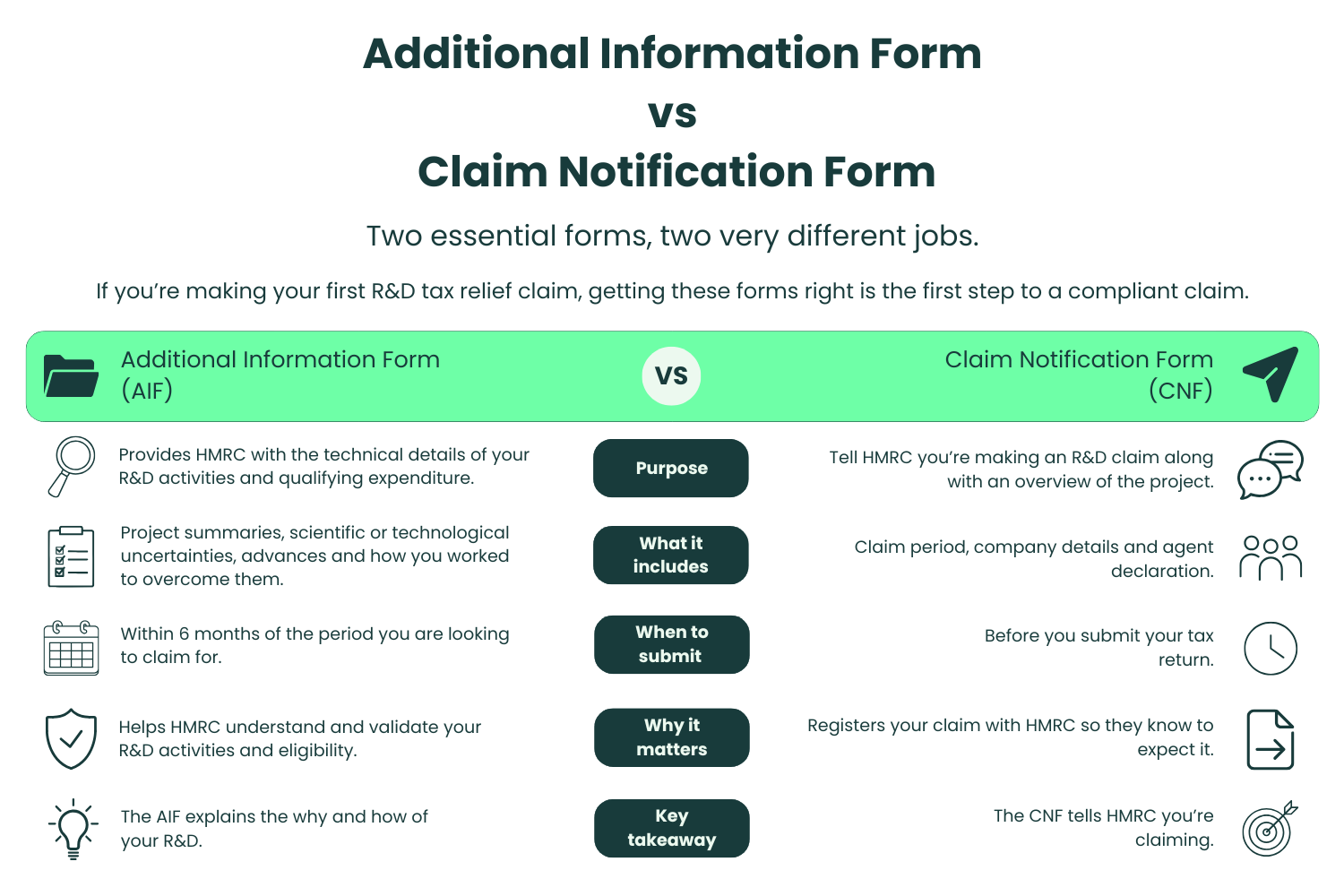
Before submitting an R&D tax relief claim, businesses should confirm whether they are required to submit a Claim Notification Form (CNF). The CNF applies to many companies that have not claimed R&D tax relief in a valid claim that was made during the period of 3 years ending with the last day of the claim notification period, and must be submitted within six months of the end of the relevant accounting period.
The information required for the CNF is company details, the company’s Unique Taxpayer Reference (UTR), contact information for any third-party advisers or agents, accounting period start and end dates and a detailed summary of the project with how it meets the HMRC criteria.
The CNF should be submitted before the statutory deadline. Preparing the technical report and expenditure analysis can continue afterwards, provided the claim notification has been submitted before the deadline.
Step 6: Submit the Additional Information Form (AIF)
A valid R&D tax relief claim requires the Additional Information Form to be submitted before the CT600. If the CT600 is submitted first, the claim will not meet HMRC’s filing requirements, therefore the claim will automatically be rejected.
Step 7: Submit your Corporation Tax return (CT600)
Filing an R&D claim requires the figures to be disclosed to HMRC via the company’s tax return by submitting a Corporation Tax return (CT600) and requires a series of information about the company and its R&D expenditure.
Although this is the final step in the process, it’s arguably the most important. Any errors can delay the claim, trigger HMRC enquiries or result in the wrong amount of relief being claimed.
For more information regarding the Corporation Tax return, you can read our guide to the CT600.
What happens after you’ve submitted your claim?
After submitting the R&D claim, HMRC will process the submitted information, review for any concerns, then issue the conclusion in a cash payment or tax adjustment. If there are any errors, HMRC will more than likely open an enquiry and request further information.
HMRC often reviews and processes standard R&D tax credit claims within approximately 4 to 6 weeks. However, if there are unexpected delays or the claim is selected for a further review, this timeframe can vary. Once the R&D claim has been approved, a payment will be issued to the company’s bank account via a BACS transfer. This generally takes around 5 to 10 days to reach the bank account.
Once the R&D claim has been processed, businesses with debt offsets, HMRC may offset the payable R&D credit automatically against the other outstanding business liabilities whether that may be Corporation Tax or PAYE.
HMRC may open a compliance check where a claim has been selected as part of its risk-based compliance activity or where further information is needed to verify the claim. Businesses should retain all supporting records after submission in case additional evidence is requested.
Common mistakes first-time claimants should avoid
It is not unusual that first-time claimants may make mistakes, but with the help from a trusted adviser like us here at Alexander Clifford, these mistakes can be avoided. From vague descriptions to mismatched figures, there are many different areas that could raise concerns during the review process.
Common areas of error include:
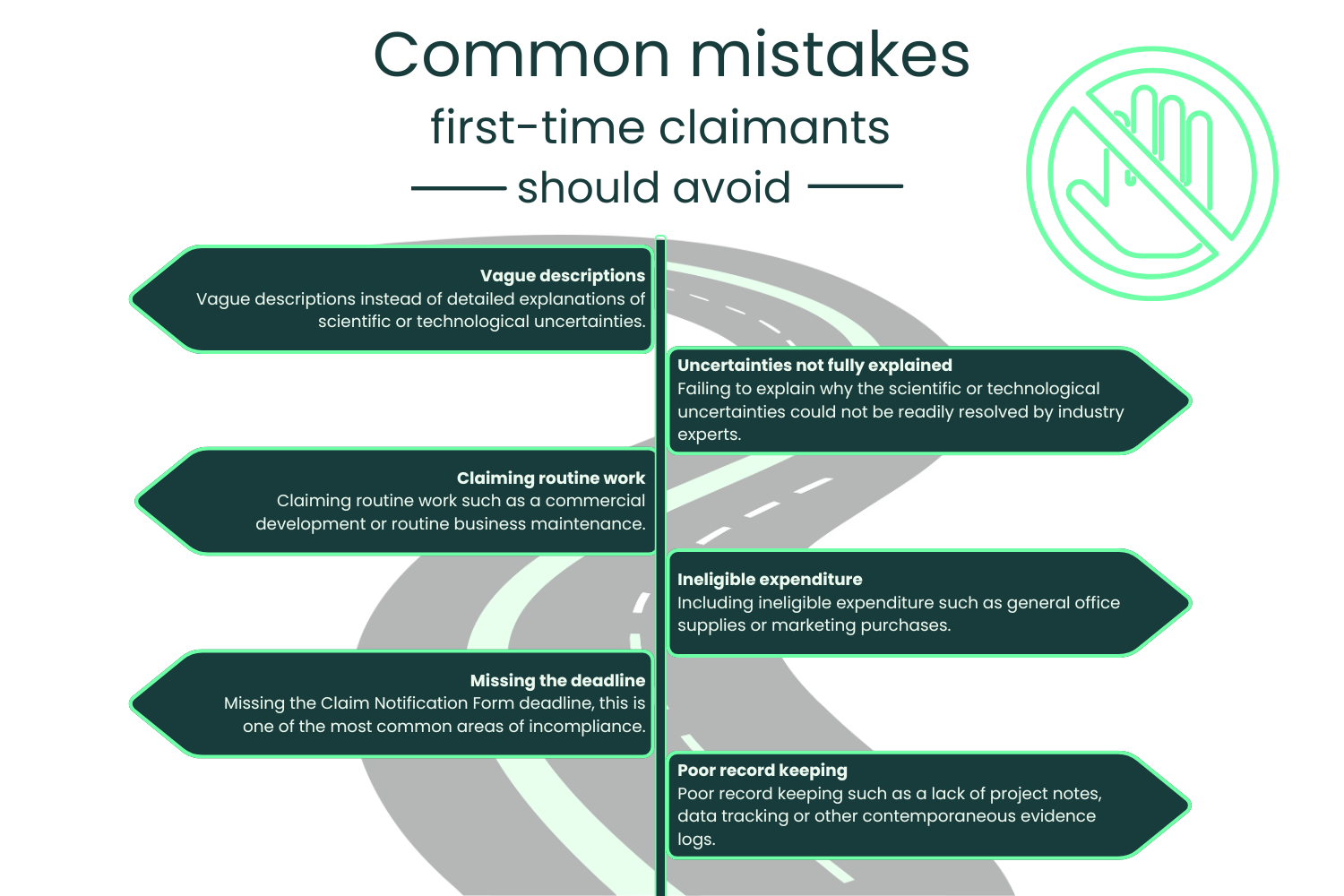
- Vague descriptions instead of detailed explanations of the scientific or technological uncertainties.
- Failing to explain why the scientific or technological uncertainties could not be readily resolved by industry experts.
- Claiming routine work such as commercial development or generic routine business maintenance.
- Including ineligible expenditure such as general office supplies or marketing purchases.
- Missing the Claim Notification Form deadline, this is one of the most common areas of non-compliance for businesses who have not claimed before.
- Poor record keeping such as a lack of project notes, data tracking or other contemporaneous evidence logs.
Closing thoughts
Making an R&D tax relief claim can be complex, particularly if you’re unfamiliar with HMRC’s eligibility criteria or evidence requirements. An experienced R&D tax specialist can help you avoid common mistakes and prepare an accurate, well-supported claim.
This is just as valuable for businesses reviewing previous claims or checking they’re using the correct scheme and following HMRC’s latest guidance. Specialist advice helps ensure your claim reflects your qualifying R&D activities and eligible expenditure.
At Alexander Clifford, we support businesses at every stage of the R&D tax relief process, from first-time claimants through to experienced companies looking for a more specialist approach with submitting a claim or even handling an enquiry.
If you’re considering making an R&D tax relief claim and would like clear, practical guidance, our team is here to help you understand your eligibility and navigate the R&D process with confidence. Get in touch and start your R&D tax credits journey today.