01614578100
 hello@alexanderclifford.co.uk



For companies who are required to submit a Claim Notification Form, it is vital to keep track of when the submission deadline is. If the deadline has passed, the R&D tax relief claim for that accounting period will be invalid. This means that the company cannot make a valid R&D claim for that specific accounting period, even if the underlying R&D activities and expenditure qualify under the legislation.
In some circumstances, the CNF may not be required for the claim. In this guide, we are going to be explaining when a CNF is required in the R&D claiming process, what happens if the deadline has passed and what companies must do before deciding next steps.
When is the CNF deadline and who needs to submit one?
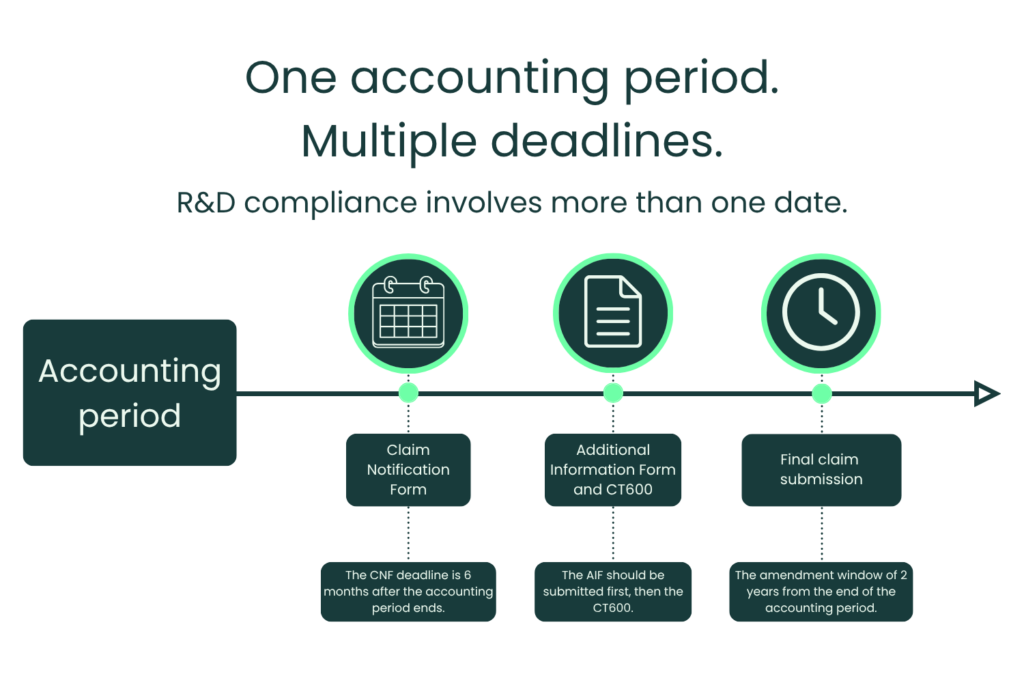
The Claim Notification Form (CNF) deadline is 6 months after the last day of the period of account that the company is claiming for. First-time claimants must submit a CNF. This requirement also applies to returning companies that have not submitted a valid R&D claim within the 3-year lookback window ending on the final day of the current claim notification period. For example, if a company’s period of account ends on 31 December 2025, their CNF deadline is 30 June 2026.
Companies are exempt from submitting a CNF if they meet specific criteria:
- Prior claim history: They have submitted a valid R&D claim within the last 3 years (based on the date of submission), provided it was not subsequently rejected by HMRC or part of an invalid late amendment to a pre-April 2023 period.
- Early submission: The company submits its entire Company Tax Return (CT600) containing the full R&D claim before the 6-month claim notification window closes.
This deadline is strictly enforced by HMRC, with no extensions permitted and late submissions will be rejected along with the whole R&D claim for that accounting period. We strongly recommend preparing this documentation as early on in the process as possible to avoid an invalid claim.
What happens if the R&D Claim Notification Form deadline is missed?
A Claim Notification Form may not be required if the company has made a qualifying R&D claim within the previous three years, while changes to the company’s period of account can also affect the notification deadline. However, if a CNF was required and the deadline has passed, the company will be unable to make a valid R&D tax relief claim for that accounting period.
There are several consequences of missing the CNF deadline, such as:
- HMRC removes the entire claim from the company’s CT600.
- There is no appeal process for a late form, this deadline is set in stone.
- Even if the R&D work fully qualifies, late CNF submission will result in no claim.
If the CNF deadline is missed, it can have a direct financial impact. While a company may have carried out qualifying R&D work and spent eligible R&D expenditure, it does not preserve the ability to claim. Where the Claim Notification Form is required, meeting the deadline is a separate requirement. This makes it crucial to establish if a CNF is needed and when the deadline is, in plenty of time before preparing the R&D claim.
What should a company do if they have missed the deadline?
Now that we’ve covered what happens when the CNF deadline is missed, it’s important to understand what companies need to do next.
If the deadline has passed, and a required CNF was not submitted, the company cannot make an R&D claim for that accounting period, they will have to wait until their next one to consider submitting.
HMRC’s rules do not provide a general extension or grace period for a missed CNF deadline. Companies that have claimed R&D tax relief previously should also review their claim history. The requirement to submit a Claim Notification Form can depend on whether the company made a valid R&D claim during the relevant three-year look-back period.
Could a missed Claim Notification Form affect future R&D tax relief claims?
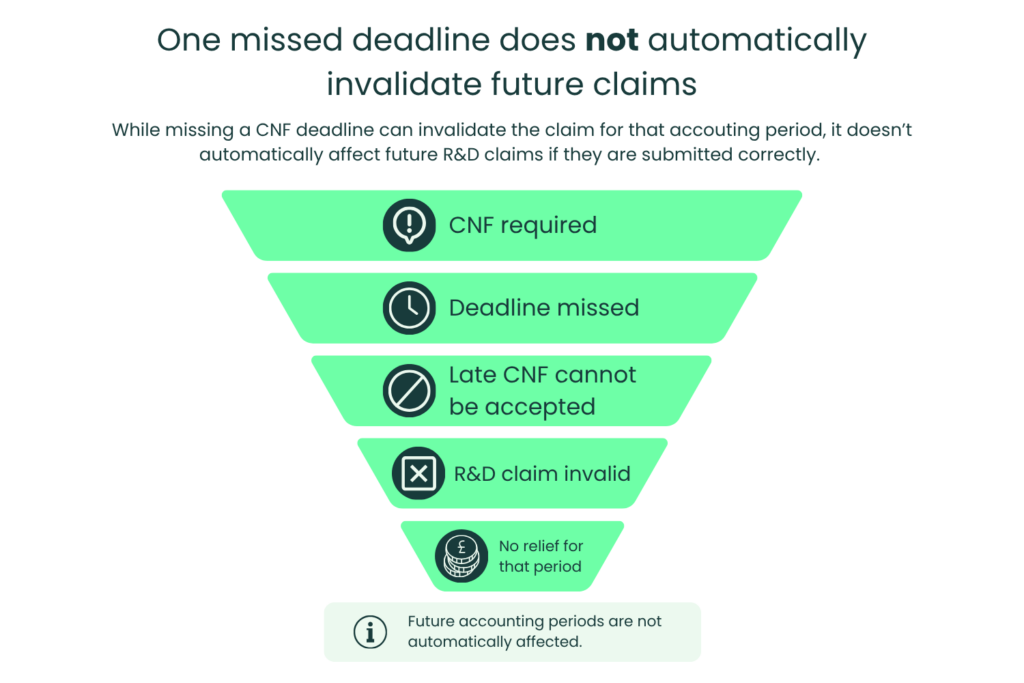
Where a Claim Notification Form (CNF) is required but isn’t submitted within the relevant deadline, the R&D tax relief claim for that accounting period will generally be invalid.
Missing the CNF deadline does not prevent the company from making R&D tax relief claims for future accounting periods. Future claims can still be made where the relevant eligibility conditions and notification requirements are met.
It does mean that the company should check the notification requirements carefully for each future accounting period and ensure that all required submissions are made to HMRC within the applicable deadlines.
How can companies avoid missing their next R&D tax relief deadline?
Companies can avoid missing R&D deadlines by following key tracking and compliance strategies:
- Track the 6-Month Notification Window
Identify the exact accounting period end date. If a Claim Notification Form is required, it must be submitted within the applicable six-month claim notification period. Whether notifying HMRC is required can depend on previous R&D claims, the relevant three-year look-back period and the company’s periods of account. Submit the required Claim Notification Form to HMRC before the applicable deadline.
- Set Long-Term Submission Alerts
Keep separate alerts for the CNF deadline, Corporation Tax return filing deadline, R&D claim deadline and Additional Information Form (AIF) requirements, as these are separate parts of the claiming process. The standard filing deadline for a CT600 is 12 months from the end of the accounting period. Where an AIF is required, Alexander Clifford’s process is to submit it before the Corporation Tax Return containing the R&D claim.
- Maintain Real-Time Documentation
Keep continuous records of qualifying R&D activity throughout the accounting year, capturing both technical challenges and qualifying expenditure as they happen.
- Assign Internal Ownership
Designate a specific team member or project lead to take responsibility for gathering claim data and managing submission timelines.
- Retain Submission Evidence
Always download and securely store receipts and confirmation copies of all HMRC digital submissions.
- Partner with Professionals
Working with an R&D tax adviser can help companies establish which submission requirements apply, identify the relevant deadlines and prepare the information needed to support the claim. Alexander Clifford specialises in R&D tax relief and manages the process around HMRC’s current requirements.
Why choose Alexander Clifford?
Choosing Alexander Clifford for your R&D tax relief claim submission can reap great benefits. Our process is designed to ensure that every company that puts their trust in us has a claim submitted to HMRC that is technically accurate and receives a low-hassle process.
As a specialist R&D tax consultancy, we combine expert financial analysis with robust technical writing to maximise your R&D tax relief while keeping any risks to a minimum.
Key reasons to partner with us include:
- Extremely low enquiry rate- Our focus on precise documentation keeps our HMRC enquiry rate below 1%.
- No win, no fee structure- You only pay if your claim is successful.
- Cross-sector expertise- We handle complex claims across multiple industries from healthcare to engineering.
- We specialise in HMRC compliance- Our team of financial and technical specialists focus on getting any details, qualifying activity and eligible expenditure compliant, with every claim prepared around HMRC’s requirements.
- End-to-end management- At Alexander Clifford, we manage all communication with HMRC on your behalf. We handle all the heavy lifting from eligible activity identification to the final payout.
- Clear and transparent communication- One thing our clients consistently value is a clear, straightforward experience. Our reviews often highlight how the Alexander Clifford team makes complex aspects of an R&D tax relief claim easier to understand, with clear updates throughout the claim timeline. We take care of the details and keep your team informed, reducing the administrative burden so you can stay focused on your research and development.

Closing thoughts
R&D tax relief claims now involve several submission requirements, each with its own purpose and timing. The Claim Notification Form is one of them. Companies may also need to consider the Additional Information Form, Corporation Tax Return deadlines and the supporting technical and financial information needed to prepare a compliant claim.
Missing a required deadline, such as the CNF, can have consequences that can’t always be corrected later. That’s why R&D tax relief should be managed as an ongoing compliance process, rather than something considered last minute when deadlines are fast approaching.
At Alexander Clifford, we manage the R&D tax relief process from the initial eligibility review through to submission. This includes establishing the relevant accounting periods, checking whether a Claim Notification Form is required, identifying applicable deadlines and preparing the technical and financial information needed to support the claim.
Our specialists work with businesses across the nation to identify qualifying R&D activities, eligible expenditure and the technical uncertainties addressed by the company. We also keep track of the submission requirements that apply to each accounting period, helping reduce the risk of an administrative deadline being overlooked.
If your company carries out R&D, speaking to us early gives our team more time to establish what needs to be submitted and when. We can review your position, explain the relevant requirements and manage the process through to completion.
Contact Alexander Clifford today to discuss your R&D tax relief position and put a clear process in place for your upcoming submission deadlines.