01614578100
 hello@alexanderclifford.co.uk



The new R&D rules for overseas R&D expenditure can seem complex. Many innovative firms have been left confused about whether they can claim on R&D overseas costs linked to abroad activities. We break down the new regulations – from the rules on overseas subcontractor R&D, to overseas expenditure R&D tax for externally provided workers (EPW).
Find out what the overseas R&D restrictions are, how they’ve changed and how you can determine your eligible R&D overseas costs.
What are the rules on overseas R&D expenditure now?
Overseas R&D expenditure means any work that you carry out abroad. Under the new legislation, R&D overseas expenditure (payments for R&D carried out abroad) is now generally ineligible for tax relief. However, there are limited circumstances where the overseas work must necessarily take place outside the UK, and HMRC may make an exception for this.
Previously, some R&D overseas costs could qualify under the term “qualifying overseas expenditure” if certain conditions were met; that term and approach have now been removed in favour of stricter rules.
What are the recent changes to the overseas R&D rules?
From accounting periods beginning on or after 1 April 2024, most R&D overseas costs can no longer be claimed under the new R&D tax relief schemes (merged scheme and ERIS). Previously, overseas R&D – if genuinely necessary abroad – could qualify under specific conditions.
Impacted Categories
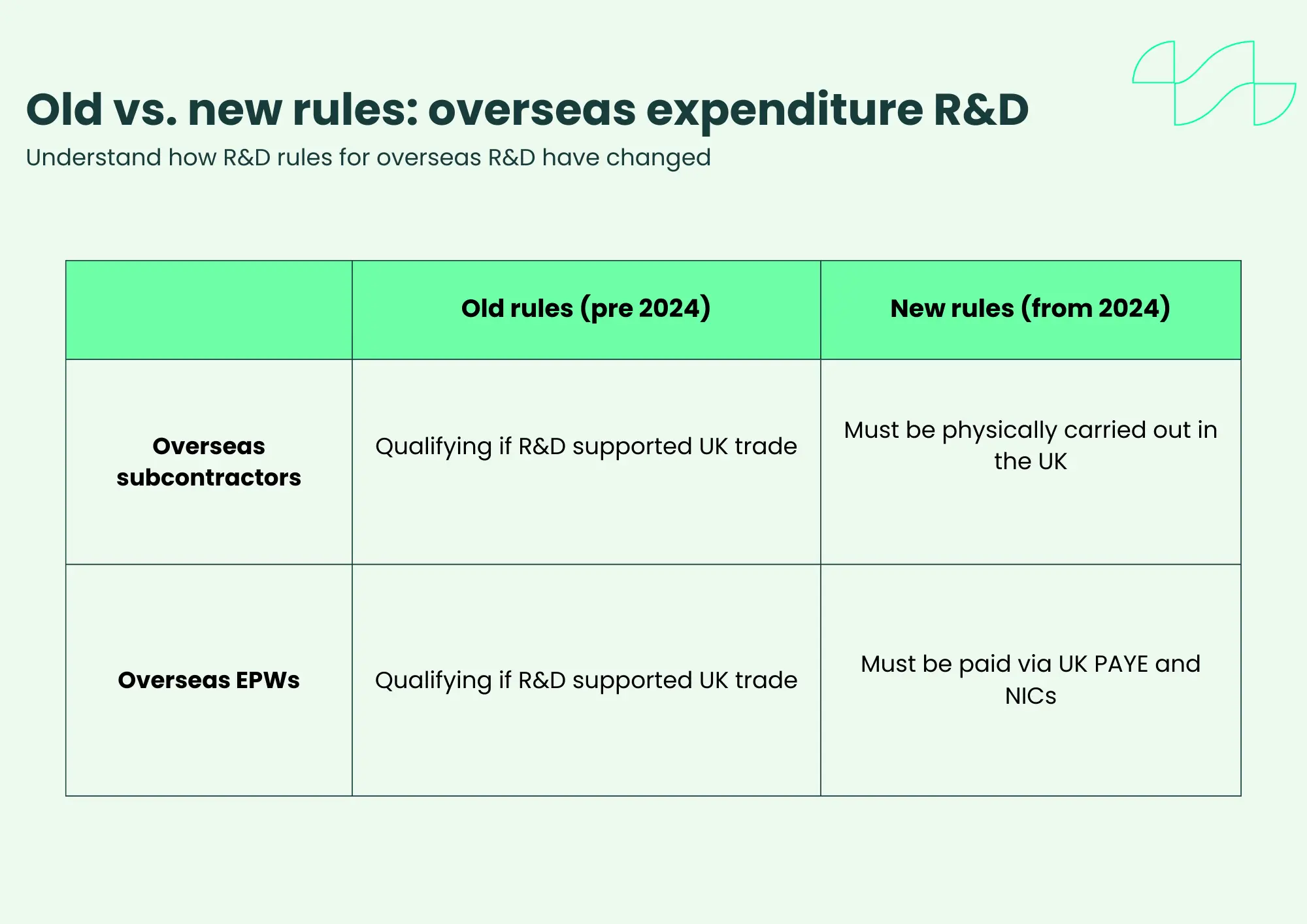
Two key areas are affected by the overseas R&D restrictions:
- Externally provided workers (EPWs) – R&D overseas costs for EPWs are only eligible if the workers are subject to UK PAYE and Class 1 NICs. Payments for overseas EPWs without UK payroll treatment are excluded
- Subcontracted R&D (R&D work subcontracted to entities abroad) – overseas subcontractors R&D is generally ineligible. Relief only applies where the R&D is physically conducted within the UK
Whether you’re claiming through the R&D merged scheme, or you’re considering your R&D intensive support (ERIS) eligibility, find out what the overseas expenditure R&D tax rules are.
Contact our specialists to future-proof your R&D tax strategy.
Claim your free 15-minute R&D tax strategy session
The new rules explained: what are the stricter R&D overseas restrictions?
What are the most recent overseas changes to the R&D scheme?
For accounting periods beginning on or after 1 April, 2024, most overseas R&D costs for R&D are generally no longer eligible for relief. This is the core of the R&D overseas restrictions.
Why has the UK government made changes to overseas R&D rules?
The government’s policy objective for the overseas expenditure R&D changes is to focus incentives on R&D activity that generates “spill-over benefits” within the UK economy.
The aim is to keep more money in the UK and help UK businesses to generate more growth into the future. This is in keeping with other recent changes, like the PAYE cap which ensures more tax credits go towards UK payroll costs.
Both PAYE (pay as you earn) and Class 1 NIC (national insurance contributions) are added together in the same cap.
HMRC introduced the PAYE restriction to R&D claims to ensure that only businesses contributing through UK employment and National Insurance benefit fully.
Impacted categories: overseas subcontractors R&D, and R&D tax overseas employees
Using contracted out R&D means subcontracting activity to another company. The stricter R&D overseas restrictions introduced in 2024 affect two primary categories: R&D overseas subcontractors and R&D tax overseas employees.
1. Overseas subcontractors R&D
When claiming for periods of account beginning after 1 April 2024, R&D activities must be physically carried out in the UK to qualify. This means that if your business relies on an R&D overseas subcontractor, their work will no longer attract relief unless it is performed within the UK.
Example 1 (non-qualifying R&D overseas subcontractor):
A UK construction firm subcontracted a piling design component to a specialist agency overseas. The design work, which involved R&D, was physically conducted in the Netherlands. This subcontracted overseas R&D expenditure did not qualify under the new overseas rules.
2. Externally provided workers (EPW) / R&D tax overseas employees
Payments to externally provided workers are subject to overseas R&D restrictions – and must now be subject to UK PAYE and Class 1 National Insurance Contributions (NICs).
This excludes most overseas-based workers, even if they contribute to legitimate R&D projects. Companies must reassess their reliance on R&D tax overseas employees.
Example 2 (non-qualifying EPW):
A UK renewable energy company engaged a remote developer in Sweden whose earnings are not subject to UK PAYE/NICs. Even though the R&D was genuine, the payments for this externally provided worker (EPW) did not qualify for R&D tax relief under the new rules, so these costs had to be excluded from the claim.
Use our free R&D eligibility checker. Speak to an R&D tax specialist today for a personalised review.
When does R&D overseas expenditure still qualify?
Overseas expenditure R&D tax only qualifies if you pass the three-part statutory test. All three conditions must be met – not one or two.
Condition 1: Conditions are not present in the UK
This means that the conditions you need to work in do not exist within the UK. “Conditions” refers to geographical, environmental, social, or legal factors. For example, if you’re studying flora and fauna not present in the UK, this may be a valid reason for conducting work abroad.
Condition 2: Conditions are present in the overseas location
This means that the conditions you need to work in exist outside of the UK. If there’s a strong need for you to complete your work overseas, HMRC may still allow you to claim R&D.
The overseas site must offer the necessary conditions to complete the work – not just lower labour costs. For example, studying desert habitats is work which is not present in the UK, but does exist overseas.
Condition 3: It would be wholly unreasonable to replicate in the UK
This is the decisive step. HMRC expects evidence that replication in the UK would be impossible or entirely impractical.
Examples of qualifying R&D overseas expenditure (wholly unreasonable to conduct in the UK):
- R&D on volcanic activity – because these geographical conditions are not present in the UK
- Clinical trials for a vaccine for an illness only found in a specific region – because this region does not exist in the UK
- Biocompatibility testing in the United States – because the FDA requires that certain trials be run in accredited US laboratories for devices entering the US healthcare market
- R&D moved to an overseas test facility as one was not available in the UK – because the project had a narrow testing window
HMRC will not accept certain reasons for working abroad if they feel the move was not strictly necessary.
Non-qualifying factors of qualifying R&D overseas expenditure:
- Cost savings – cheaper overseas labour is not an exception
- Workforce availability – difficulty hiring in the UK is not a valid reason
Free R&D Tax Credit Calculator
Before you begin your claim, find out how much your business could claim.
Can I submit an R&D claim for a branch of an overseas company?
Making an R&D claim for a branch of an overseas company depends on strict eligibility rules. The key requirement is that the UK entity must be subject to UK corporation tax and must bear the financial risk of the R&D overseas costs.
Eligibility criteria for R&D overseas expenditure
Overseas expenditure R&D tax may be eligible if it includes:
- UK-registered subsidiaries: A UK subsidiary of a foreign parent can claim if it carries out, funds, and takes the risk for the R&D project
- Branches of overseas companies: A branch registered in the UK can also claim, provided it pays UK Corporation Tax on the R&D activities
Overseas expenditure R&D tax rules
Even where overseas R&D takes place, only qualifying expenditure passes under the 2024 restrictions and three-part exemption test. Payments to R&D overseas subcontractors and R&D tax overseas employees will not normally qualify unless they meet the strict exemption criteria.
Practical considerations
- Inter-company agreements should clearly set out which entity is undertaking and funding the R&D
- The UK connection must be demonstrated, with the UK branch or subsidiary showing it controls, directs, and bears risk for the R&D
- Expenditure must meet the new restrictions on overseas R&D costs, with exceptions only where replication in the UK would be wholly unreasonable
Example: qualifying subsidiary claim:
A branch of an overseas company set up a limited company in the UK which is subject to corporation tax. This branch was able to successfully claim for R&D tax credits even though the company overseas did not.
R&D overseas expenditure – practical implications & compliance
What evidence do I need to keep?
To support your R&D claim, HMRC expects thorough documentation that shows evidence of your work:
- Contracts and invoices with R&D overseas subcontractors or externally provided workers (EPWs)
- Project plans, technical reports, and progress updates
- Emails, meeting minutes, and internal memos that explain why overseas R&D expenditure was necessary
- Evidence linking the UK entity’s financial risk to the expenditure
Keeping a full audit trail is essential to a successful claim, especially where overseas activities form part of your R&D overseas costs.
How are branches of an overseas company impacted?
Making an R&D claim for a branch of an overseas company now requires even greater care.
- The UK branch or subsidiary must be paying UK corporation tax
- The company must fund and control the R&D, not simply act as a delivery arm for its overseas parent
- Only R&D overseas expenditure that passes the three-part exemption test can qualify
Failure to prove these points could result in HMRC rejecting the claim.
Strategic implications & future planning for international businesses
Multinationals must reassess their global R&D strategies in light of the 2024 R&D overseas restrictions:
- Restructure R&D supply chains so that qualifying activities are carried out within the UK where possible
- Reallocate roles to UK-based staff or subsidiaries to ensure PAYE/NIC compliance for EPWs
- Use inter-company agreements that clearly allocate R&D risk and costs to the UK entity
- Build contingency into project design for exceptions to overseas expenditure, applying the three-part test
Expert advice is now critical. A tailored review of your international R&D set-up can safeguard compliance while maximising eligible overseas R&D expenditure.
Frequently asked questions (FAQs)
Does this mean none of my R&D overseas expenditure now qualifies?
No. While most overseas R&D expenditure is excluded from April 2024, some R&D overseas costs can still qualify if they meet the strict three-part exemption test. These involve work with conditions not present in the UK, present overseas, and wholly unreasonable to replicate in the UK.
Can I still claim for an overseas subcontractor R&D if the work was done on a UK project?
No – subcontractors are subject to R&D overseas expenditure restrictions. The new rules state that R&D subcontractor work must be physically carried out in the UK. Even if the project benefits a UK trade, subcontracted work done abroad will not qualify unless it passes the limited exemption test.
Do these R&D overseas restrictions affect my UK-based employees working remotely from abroad?
Yes. If an employee is working abroad but still on the UK payroll and subject to UK PAYE/NICs, their R&D overseas costs can qualify. If they are not on UK PAYE/NICs, the expenditure will not qualify.
Does the PAYE/NIC rule for R&D tax overseas employees apply to connected parties?
Yes. The PAYE/NIC requirement applies to all externally provided workers (EPWs), whether connected or unconnected. If payments are not subject to UK payroll taxes, the expenditure cannot be claimed.
What is the difference between claiming for externally provided workers (EPW) and an R&D tax overseas employee?
An EPW (externally provided worker) is supplied through an agency or staffing provider and must be paid via UK PAYE/NICs to qualify. An R&D tax overseas employee is a direct hire based outside the UK. Their costs generally do not qualify unless the exemption rules apply.
Is there any de minimis rule for overseas R&D overseas costs that are still eligible?
No. There is no minimum threshold that allows R&D overseas expenditure costs to slip through. Every claim must be tested against the three statutory conditions.
Next steps: get expert guidance
The new restrictions on R&D overseas expenditure are complex, with strict tests and compliance requirements. These affect externally provided workers (EPW) and overseas subcontractors R&D. A small oversight could mean losing valuable relief or facing an HMRC challenge.
At Alexander Clifford, we specialise in helping innovative businesses navigate these changes with confidence. Whether you need to understand how the rules apply to your overseas projects, restructure your R&D activities, or simply check if your current claim is compliant, our team is here to help. Get expert guidance on claiming overseas R&D exceptions. We can help you secure successful R&D tax relief for overseas subsidiaries.
Schedule a free 15-minute consultation to see how we can help maximise your tax relief.